


2013 – 2014 Anon M1 Snow Goggle
Features:
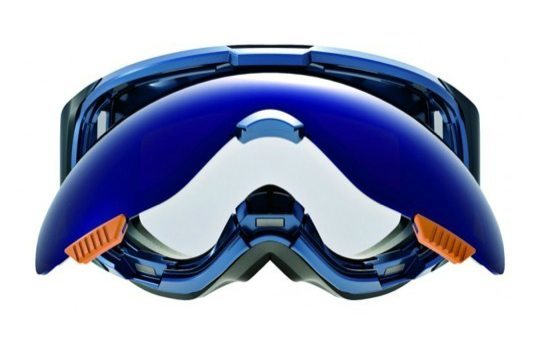
Magna-Tech Quick Lens Change Technology
Triple Layer Face Foam
Pivoting Outrigger
Spare Greybird Lens Included
Nylon Compression Molded Case Included
Test Locations: Taos Ski Valley, Las Leñas Ski Resort, Crested Butte, Summit County.
Days Tested: 40+
[Editor’s Note: Having spent more time in the M1, Will Brown has updated his review. Pay particular attention to the Optics section.]
In my review of the Smith I/O goggle two years ago, I mentioned that having multiple lenses at your disposal is crucial if you’re serious about shredding hard in all conditions, from whiteout to bluebird, or you just want to be as safe and prepared as possible on the mountain. This is still true, but now number of other brands sell goggles with interchangeable lens systems. Smith is no longer alone, and arguably no longer the best in the game.
Last season, Anon came out with the M1 Goggle and an impressive interchangeable lens technology that’s free of a mechanical locking system. Unlike Smith’s I/O, I/OX, I/OS, Oakley’s Airbrake, and Scott’s LCG (review to come), which all use a latching mechanism of some kind, Anon’s “Magna-Tech” system uses six neodymium magnets seated around the perimeter of the goggle’s frame to hold the lens in place.
This season, Anon released the M2, a rimless version of the M1 with a larger fit and the same magnetic lens retention.
Compared to the competition, we’ve found that both the M1 and M2 undoubtedly offer the quickest, simplest interchangeable lens system on the market, and are two of the best goggles we’ve tested to date.
But the newer M2 is not necessarily a better M1. The M2’s larger fit will suit some people better than others (just as some prefer the fit of the I/OX over the I/O).
This review mainly covers the functionality and performance of the M1 alone. You can read more about the notable differences in fit and the differences in function (which are extremely minor) between the M1 and M2 in our review of the M2.
Functionality
After the first day of testing, one thing was very clear: the M1’s “Magna-Tech” system is incredibly easy to use. No real surprise there. Prying at either of the lens’ bottom, outer magnets will partially detach it from the frame. With one of the corner magnets lifted, you can pull the lens free in a second (literally).
To drop in a lens, generally align the magnets on the top of the frame with those on the lens and let go; everything snaps in nicely. Yes, you can pull the lens on and off while the goggles are still on your face (and, yes, the look people give on the chairlift will be one of confusion).
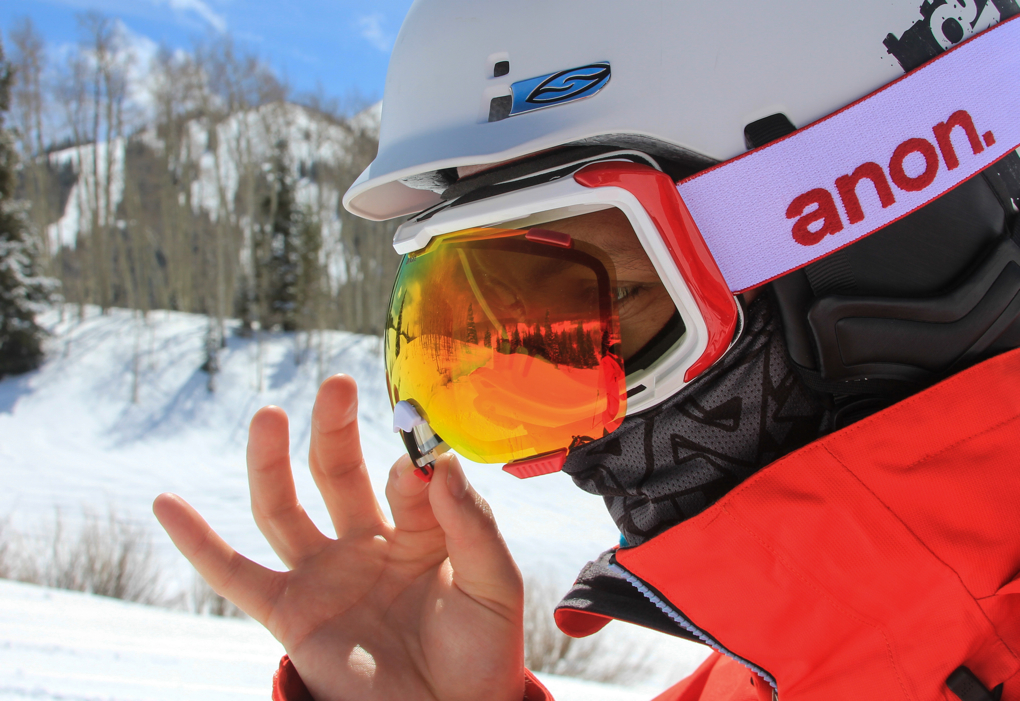
The M1’s entire lens swap procedure is far less involved than the Smith’s I/O’s or the Switchlock system on the Oakley Airbrake, but it still requires a little finesse. There is a basic method to changing the M1’s lens—it’s not easy to yank off any which way. (Try peeling a sticker without first lifting one of the corners.) The video below makes swapping the lens out while wearing the goggle look incredibly easy, and I can vouch—once you get a feel for the frame and where the lower magnets are, it is that easy.
I should point out that because the M1 lens’ bottom magnets and their surrounding housing fit into designated notches / sockets on the frame, it’s not impossible for the lens to seat slightly off so that not all the magnets are engaged fully, and small gaps are left between the lens and frame. This doesn’t happen often, but if it does you’ll just need to lift and reseat the lens, which is not a big deal, not at all.
In this respect, if we’re splitting hairs, the “frameless/rimless” design of the M2 makes correctly swapping in a lens 100% foolproof because there are no tabs and notches to be seated poorly, where it’s 99.8% foolproof on the M1 for this reason.
I would not buy the M2 over the M1 on those grounds – the difference in fit between the two will probably be a deciding factor for some people, and is ultimately way more important.
Swapping lenses on the M1 is insanely easy, and it’s insanely, ridiculously easy on the M2.
Like the Smith I/O, the M1’s frame is pretty flexible on its own; it bends and twists to a certain degree. Torquing either end of the frame doesn’t cause the lens to dislodge whatsoever but I’ve found that if I pinch the goggles under the nose piece and the top of the frame while pulling hard on the strap (as you might do in pulling the goggles on over a helmet), some of the magnets can disengage momentarily as the frame gives slightly. This rarely happens, and when it does the lens is always secure once the goggles were are place.
This brings me to what is probably the most important point about the M1, and something that most people are likely to be skeptical about: lens retention.
The M1’s lens may be wonderfully simple to swap out, but if there’s a good chance it won’t stay put when you need it to (i.e. during a nice tomahawk) then what’s the point?
Lens Retention
Anon says they didn’t have any problems with lens retention during testing:
“The goggle design has 6 magnet connection points, and when all are fully bonded, the combined retention can hold up to 20 lbs. Our pro riders have been testing the product on snow for months. To date, we have yet to hear a complaint about the lens coming off of the goggle on impact. In addition, we’ve been putting the goggle through lab retention tests that are very similar to the way Burton tests the retention of their snowboard bindings. So far, we’ve yet to find the maximum retention level, but we’re up to an impact of over 75Gs without failure.”
My experience with the M1—which has included one particularly brutal wipeout (think face to frozen slush at ~40 mph, with jeers from the chairlift)—has been consistent with Anon’s claims.
Of course, the hypothetical, “Well, what if” crash scenarios are endless in trying to think about potential failure points of such a design. Apart from what has already been explained, I will say this: If you find yourself in a situation in which you do somehow manage to separate the M1’s lens from the frame, the whereabouts of the lens will probably be the least of your concerns.
Bottom line: I am not at all worried about the M1’s lens retention.
Vision, Fit & Venting
In terms of peripheral vision, the M1 seems identical to the I/O: both are awesome.
I have noticed that the M2’s frame doesn’t seem to protrude quite as far into my periphery as the M1’s, particularly on either side or on the bottom of the frame. This isn’t a huge difference, and both the M1 and M2 offer a sufficiently clear, unobstructed field of vision. If the standard frame size of the M1 happens to fit you better than the M2, don’t worry, you’ll still be able to see just fine with the M1.
The M1 fits very similarly to the face as the I/O, with a nearly identical outrigger system and comfy, triple-density face foam. The M1 is slightly deeper, with more venting area behind the front of the frame. People who have experienced fogging issues with the I/O may be glad to hear this.
The M1 does offer a slightly narrower fit than the M2, like the Smith I/OX compared to the I/O, so if you know you prefer a goggle with a decidedly larger fit, you may want to consider the M2 over the M1. (Again, you can read more about this differences in fit in our review of the M2).
The M1 integrated perfectly with a Bern Watts helmet, Smith Variant Brim, and RED Mutiny. I have had some minor fit issues wearing the goggle with my Smith Gage: there is a small gap between the top of the goggle frame and the helmet. This isn’t very noticeable though, and it’s never bothered me.
The M1’s venting and fog-prevention seem every bit as good as the well respected I/O. In over 40 days of testing, I haven’t identified any shortcomings in this area, and at this point I don’t expect to. Now on to optics/lens options.
Those look great. I’m sure you’ve seen the new Scott interchangeable system. Was using a pair this weekend at Alta. It’s a tidy set up.
We sure have, Aaron. Nice to hear you’re a fan. We’re going to start logging time in Scott’s LCG soon, along with a production version of Anon’s M1 and the new M2 – there’s a lot out there to get stoked about in the interchangeable lens game these days. Stay tuned!
Will B
For some other info about the M1s they really were the easiest goggle I have ever used when swapping lenses. I even used them on a powder day and tomahawked twice that day and yard saled once and the lenses never detached so the magnets did their job. My only complaint about the M1 was that while riding fast and riding the lifts wind constantly came through the lenses around the frame. And on the next day when it was snowing snow flakes continued to flow through the areas of the lenses where wind was coming through as well disrupting my vision. My magnets were aligned correctly and it was not user error but turned out to be a manufacturing defect and thanks to Burtons rider warranty and my explanation of the problem Burton/Anon refunded my money on the M1s. After seeing the Changed made to the M2 I can’t wait to hear a review because I am interested in buying the M2s. Hope this comment helps
Hey Mike,
Thanks for weighing in. As far as I know, the design tweaks made to the M1 should totally eliminate any gaps or spaces between the lens and frame around the magnets. I can’t say I ever had problems like that with the pair I tested, but I’ll be sure to check this with the 13/14 production pair we’ll test. And yes, we’re really excited to take a look at the M2 as well.
Cheers,
Will
Hi Will – I have a question and a tip for other M1 users. First my tip is be careful how you clean these lenses – i washed the lens under the tap after a days use and the water got between the two lenses through the foam. i havent been able to see if its stained the inside of the lens yet – but if there is a water mark im guessing its impossible to clean out. Now can I ask a question please – Is the womens range of M1’s a smaller frame size or just different designs?
Hey Martin,
That’s a real bummer. I would try either putting the lens in a bag of dry, raw rice for a day or two. There’s a chance the rice will pull some of the moisture out of the lens. The other, ideal option would be to put the lens in a plastic bag with a bag of silica gel (not that you’d have one handy, but they’re the little baggies of “DO NOT EAT THIS” beads that sometimes come packed with a new pair of sneakers or electronics).
All and all, though, a ride under the tap may have spelled the end for your lens. For future reference, just use the goggle case your M1s came with to clean the lens – of you need a little moisture to get some fingerprints off, then breathing on the lens, creating a little condensation, should suffice.
As for the new WM1, I don’t know for sure, but Anon is calling it a “women’s specific design”, so I believe the frame dimensions are slightly different than the (men’s) M1.
Will
Thanks for the great review. I have loved my M1 goggles over the last year but I thought I should post to let people know that the lens retention is not wonderful for all people. I had an incident where someone got tangled up with me getting off a chairlift and I took a very slight fall in which I landed on my side and the side of my face. The lens popped out and the center top magnet broke off as well. The breaking off of the magnet also caused the lens to crack in that location. I have had the lens pop out several times before as well. A friend of mine also has a pair and he had the same magnet break off on a fall (albeit a nasty one). I don’t know if my head is just not a good shape for the M1 and leads to the lenses popping out fairly easily but it is a bummer to have an awesome goggle that has not quite lived up to the reviews or the cost.
I’ve used a pair of these for about 30 ski days so far, and have a couple of impressions I’d like to share. These are my first foray into ‘hi end’ goggles / optics and replaceable lens technology. Previously skied for about 10 years with a $40 pair of Spy goggles with a yellow tinted lens.
1) Everything said about the ease of lens change is absolutely correct. They are multiple times easier than changing those on my son’s IO7’s. If you feel the need to be able to swap lenses, you have to give these a look.
2) Construction details seem very good.
3) Regarding the venting, to me, these seem to have to much! My eyes can tear with these on while going up the chairlift if the wind is coming from the right direction, never mind while skiing. I’ll probably try to tape over some of the side vents; just seems that shouldn’t be necessary with a $200 pair of goggles. The cheap Spy’s I skied with previously did not exhibit this behavior, nor were they bothered with fogging issues.
4) Lens / Optics. Mine came with the Red Solex / Blue Lagoon combo. I agree with the reviewer’s comments about the Red Solex. I find the clarity and glare reduction top notch on Bluebird days, and, it’s also not too bad when you dip into the shadows. A great lens. Now, as for the Blue Lagoon, I’ll have to disagree with the reviewer. I was very unimpressed with that one. While it did perform better in low light than the Red Solex (as you’d expect), I didn’t think it was all that much better than my 10 year old Spy ‘economy’ yellow lenses. Maybe not even as good. It didn’t really light things up, and, didn’t seem to improve the contrast and detail of the snow surface conditions all that much. And with the mirror coating, in low light, I could see reflections of my eyes, which took away from the clarity of the image. And perhaps I was expecting too much. As I said, first foray into the high end goggle realm.
My primary reason for looking at this level of goggle, with the replaceable lenses, was to have improved low light visibility. That doesn’t seem to be the case, at least not to the extent that I feel would make the goggles worth the price. What I’lll probably end up doing is returning these and get a less expensive variety with a good single lens of 50% VLT or thereabouts. That’ll likely be good enough.
Just noticed the first comment also mentioned the wind. Mine don’t seem to have any manufacturing defect that I can see; the lens seems to seal tightly to the frame. Just the vents let too much wind thru, I think.
Will – how would I tell if this pair predated the ‘design tweaks’ that you mention above?