

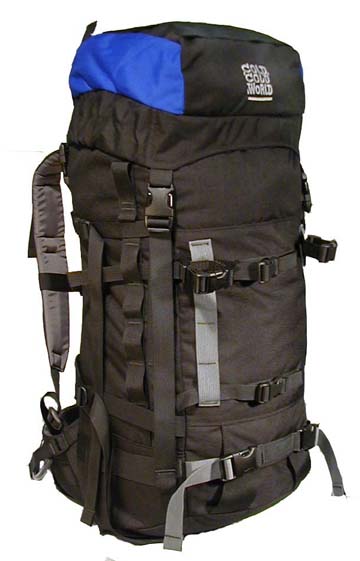
 Cold Cold World Chernobyl
Size: Custom 20–23”
(also offered in Regular 18–21” and Small 14–16”)
Volume: 49 Liters / 3,000 cu. in. (Regular);
42 Liters / 2,600 cu. in. (Small)
Weight: 3 lbs. 4 oz. / 1.47 kg (Regular)
Features:
- Quick-release removable/extendible lid
- Seperate underlid pocket for small items
- Daisy chain haul loops
- Padded hipbelt with gear loops sized to work as holsters
- Ski slots
- Universal ice tool attachment system
- Fixed quick-release crampon straps
- Removable 23″x24″x 3/8″ foam backpad
- 14″ overfill extension sleeve
- Internal hydration pocket with hose exit port (bladder not included)
MSRP: $190
Duration of Test: more than 3 years
[Editor’s Note: We posted our original review of the Chernobyl over two years ago. But Dave has continued to use the pack, so we asked him to update his review and tell us how well the pack was holding up after more than three years of hard use.]
Background: Light is Right?
Pioneered by icons like Ray Jardine, the “light is right” ideology has been espoused by nearly every gear manufacturer in the game. These days, it seems that if we’re going to do anything more strenuous than carry an item from our homes to our cars, that item better weigh as little as humanly possible. To that end, parading out low product weights—or creating product names that include the words “helium,” “zero,” or “nano”—will certainly sell a lot of gear, but often without acknowledging what’s sacrificed to achieve these weight savings.
Packs are no different, and it leaves me suspicious.
Several years ago, my search for a pack began when I realized I needed a mid-sized pack for longer climbing trips or shorter backpacking trips. This pack would have to work for day trips in the winter, as well as two-night trips in the summer.
Because I planned on using this pack for climbing-related pursuits, either at the crag or in the alpine, I began by looking for mid-sized packs that were (1) durable enough to be trailed beneath me in a chimney or hauled through a few pitches and (2) light enough that I could still bite off more ambitious objectives.
But these two criteria only further highlighted my suspicions of ultralight gear: durability/functionality and lightweight virtues are almost always diametrically opposed, and it is often hard to tell exactly how much abuse something can withstand—until till it actually breaks.
Many climbers get around this problem by simply not making durability a priority. I’ve been told many times by owners of various packs that “durability isn’t an issue as long as you don’t put your rack in on the bottom.” Sorry, but treating gear like it’s made of glass doesn’t work for me. After all, well-conceived pieces of gear are the ones I think about (and worry about) the least.
Sorting through the Options
Enter Cold Cold World. I was introduced to Cold Cold World while discussing climbing packs with a small army of climbers over a one-year period. I got scattered recommendations from most of the mainstays (Gregory, Arc’teryx, Lowe, Black Diamond, etc.), but I kept hearing glowing opinions of packs made by two small companies: Cold Cold World (based in Jackson, New Hampshire) and CiloGear (out of Portland, Oregon).
Both are small, independently run companies with the narrow focus of making packs for alpine-related pursuits. Interestingly enough, each company builds packs by hand, to order. Consequently, there is no storefront to visit, and their gear is not retailed at major outlets. This create a potential problem for those who like to try on a pack before buying it, though one can order the pack, try it on, and return it if it fits poorly.
(For the record, CCW’s return policy states they will take back unused packs so long as extensive customization has not been done. Neither Cold Cold World nor CiloGear suffer too badly from this “try before you buy” limitation, thanks to their sterling reputations and word-of-mouth recommendations.)
Without really knowing which to go for, I finally decided on the Chernobyl (Cold Cold World’s mid-range pack) over the comparably sized CiloGear worksack, based on the arbitrary personal preference that the Chernobyl was just over 4 liters larger (roughly 49 liters versus 45).
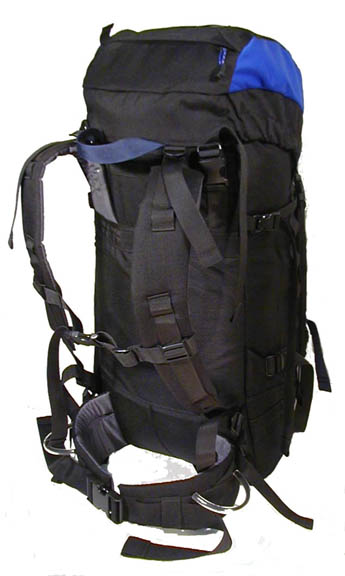
Customization of the Chernobyl Backpack
My experience with CCW began with an email correspondence with the owner, Randy Rackliff. Because the packs are assembled by hand per order, each purchase begins with an email or phone call to the shop. If not being able to try the packs on before purchase is a fact of the very small business world, so too is the ease of customization offered by Cold Cold World.
I decided I wanted snowboard straps on the back of the pack as well as the A-frame ski slots that come standard. And, since I’m 6’3”, I wanted the pack be slightly longer than their standard “Regular” size. This wasn’t a problem. I paid a fee of $25 for the snowboard straps and, over the course of an incredibly informative 16-email chain, Randy helped me customize almost any part of the pack I wanted.
For those interested in exploring these packs, there is a good sizing reference on their website. (Pack sizes are measured against the distance from the top of the hipbone to the base of the neck. Given this industry standard, it is relatively easy to get the correct measurement and get your pack to fit perfectly. In my case, this meant adding two inches to the Regular size.)
Cold Cold War’s Design Philosophy
Upon receiving the pack in the mail, CCW’s guiding philosophy became clear: don’t get too hung up on “innovation”. There is no shortage of options when it comes to packs, but one very important fact about the pack world remains: barring major breakthroughs in fabrics or materials, it is difficult to truly innovate, and pursuing the new and different doesn’t always add up to “Better”.
Cold Cold War’s gear is not gimmicky, nor does it tout new, exciting features that you’ve never heard of. Their packs aim to include the most functional features and exclude everything else. They’re just taking long-standing, proven features and attempting to incorporate them better than everyone else. Personally, I appreciate this tactic. It’s hard to overstate how little I care about features like ornate zipper loops, a dedicated hanging pouch for the iPhone that I don’t own, or how many patents my shoulder straps have.
That said, many packs on the market have certain small features that some people want. For example, the Arc’teryx Miura 50 has two gear loops inside the pack for organization. While you might not be interested in features like this, there are people who love having them, and those people shouldn’t have to feel committed to one pack or brand because they’ve grown accustomed to a handful of minor features. This is the beauty of customization: want extra gear loops? Snowboard straps? Daisy chains? No problem. Instead of having to choose between Black Diamond features and Arc’teryx features, for example, pick the ones you like from each and custom order them onto a Chernobyl.
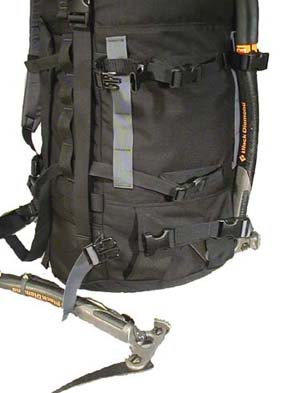
The major features of the pack include a pair of daisy chains on front of the pack as well as on the removable head, and four haul loops for chimneys or straight-up hauls. For technical gear, there are two ice ax attachment points on the back that are designed to accommodate tools universally (a loop for the shaft, and a stretch of fabric to hold the picks in place). It is worth mentioning here how wonderful this is.
Modern “ergonomic” ice tools come in a variety of shapes, and it is incredible to think that, while we can put a man on the moon, we still fail miserable and finding a way to accommodate non-traditional ice tools on packs. Between the tools sit two loops with clasps for holding crampons. Together, the tools and crampons represent one of the biggest threats to a climbing pack’s durability, and they should be mounted securely so minimize the damage that they can cause. The Chernobyl does this effectively.
is it possible to mount a snowboard vertically with these straps?