

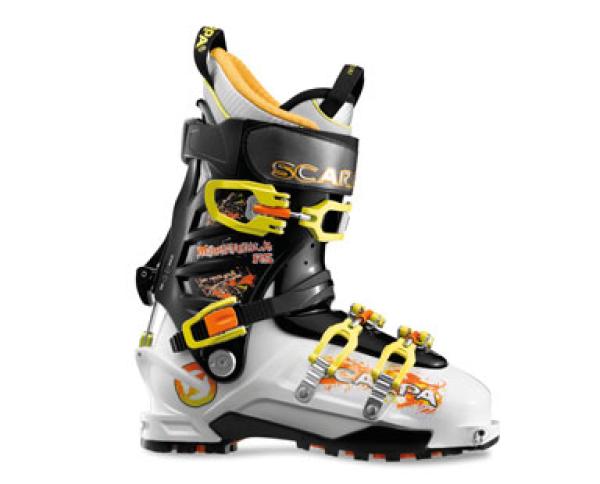
 Boot: 2012-2013 SCARPA Maestrale RS
Stated Flex Rating: 120
Stated Last: 102mm
BLISTER’s Measured Weight Per Boot: 1,315 grams (shell) + 225 grams (liner)
Boot Sole Length: 306mm at 27.0
Skier: 6’2”, 205 lbs., athletic, technically proficient, fast and fluid skier.
Foot: size 10.5/11 street shoe (278mm actual length); C+ width (105mm width, weighted); high instep; low-volume heel, ankle, and lower calf.
My Regular Ski Boots: 27.5 Head Raptor RD 130 (95mm last) with several punches for width in the instep and metatarsal heads, 26.5 Tecnica Cochise Pro Light (100mm last) as a touring boot.
Conditions Tested: Backcountry powder, sun affected, wind affected, in-bounds chalk, hard pack and spring slop. Basically everything.
Test Duration: 6 days of skiing
MSRP: $699
I should start by saying that I was only able to ski the SCARPA Maestrale RS for six days, so I cannot do my normal over-analysis. This review presents my first impressions of the Maestrale RS, and I hope to follow up later in the season with a more thorough going-over of the boot.
The Maestrale RS strives to be a no-compromise backcountry boot for the freeride skier who wants control and precision at speed on wide skis, without paying any penalty in weight or stride while touring. I do not think the Maestrale RS is intended to be a crossover boot per se, but if you have bindings that are compatible with the SCARPA’s heavily rockered sole, the Maestrale RS will be up to the task.
The Maestrale RS is an updated version of the original, now-two-season-old orange Maestrale. The RS features a Nylon shell, as opposed to the original’s Pebax shell. This new material choice makes the boot much more laterally rigid and also yields less shell deformation in the lower, making it effectively stiffer on snow. The RS also includes a stiffer tongue, which matches the increased performance of the shell nicely.
Weight
The Maestrale RS comes in at an attractive ~1,550g weight. That is weight-competitive with the new Dynafit Vulcan and Mercury, and is actually a shade lighter than the original Maestrale.
Neither of the Maestrale boots nor the Dynafit Vulcan nor Mercury boots have replaceable toe and heel blocks. If you count grams, this is likely not important to you, but if you like to switch between alpine and AT bindings, or replace the boot soles regularly when they are smoked from scrambling on rocks, replaceable soles do add about 200 grams to the system’s weight. The Cochise Pro Light boot comes in 180g heavier, but does have replaceable soles.
 Liner and Fit
I, for one, really appreciate that SCARPA includes an Intuition Pro Tour liner with this boot. They are light, warm, heat moldable, and match the shell nicely. That said, I did need to put “L-pads” around the ankle of the liner to get adequate heel hold. Should you feel heel-lift, that would be my first suggestion. (You might also be interested in reading my Intuition Liners review.)
The fit of the boot itself is very comfortable out of the box, which typically is worrisome, and often indicative of a boot that’s too big. But in this case, the initial fit is deceptively precise. The original Maestrale was roundly praised for skiing much better than its soft flex might indicate, due to a precise shape that gave the skier more control over the skis than they otherwise would in a stiffer but less anatomical shell.
The RS offers nice closure on the front fold of the ankle and lower tibia, decent heel hold, and a nicely shaped toe-box that will fit most feet without issue. I don’t really have much to say here, SCARPA really did their homework on the anatomy, and the Maestrale RS will fit most feet straight out of the box. I would compare the overall shape of the Maestrale to some of the top-selling alpine boots out there, such as a Lange RX. A very nice fit that will work with most feet.
I do think that the side-pivoting tongue arrangement is a bit finicky, and it takes a little practice to figure out how to fold the upper buckle out of the way, pivot the tongue, and then put it all back together…but it works. No harm, no foul. But expect a learning curve.
Excellent review, as always Marshal. Especially like the estimate compared to the FT. I usually run a #10 tongue in my Full Tilts, but I suspect the RS will be perfect for my needs. I was really expecting to want the Vulcan, but progressive flex > stiff flex in my book.
It’ll be interesting to see how much the weight will change if the removal of the bottom buckle and addition of a booster strap (with plastic hardware, not the steel).
yeah man, the Maestrale RS does have a pretty nice strap. Its not a full booster like the mobe used to have, but it matches the boot very well IMO. anyhow, just saying i would try the stock prior to replacing.
I think one could get flexon 10 stiffness just off a liner switch (power wrap or alpine liner), should they so desire.
Figured I’d provide an update that might be helpful to others. I bought these off of Bent Gate the day I read this review, and just got them today. (None of the local shops are stocking them yet, and I figured I’d return them if they don’t fit.)
Normal boot is a 27 Full Tilt, so I ordered a 26.5. While the Full Tilt is slightly lower volume, the 26.5 RS is a good fit. Maybe even great — almost too good, actually, for an out-of-the-box fit. I punched my Full Tilts in the 5th met head region, and probably won’t have to do that for these. Interestingly, didn’t notice much of a difference in fit between the new, stock liner and the packed-out powerwraps from my Full Tilts. Also tried them back-to-back with the Cochise 120 I used last season — I tried the Cochise on with the stock liners that I never used, so basically an out-of-the box fit there also. Much lower volume than the Cochise, and they had MUCH better heel hold. I’ll probably try on the 25.5/26 RS, but it’s probably going to be too small.
Interestingly, they felt noticeably stiffer at the 11.5 deg forward lean. Which is what I prefer anyway, so that’s fine. With the powerwraps, they felt a little softer than the Full Tilt #10 tongue (same liner) and another increment softer than the Cochise 120. I’d probably call them a FT #9 tongue. Agree that they’re about a FT#8 with the stock liners. But the flex is very similar in progression. They felt considerably a bit softer than what I remember the Cochise 120 feeling with powerwraps (different, bigger pair). But I could barely flex those at room temperature with the powerwraps installed and buckled tightly enough to take up the volume around my shins, even with a tongue eliminator shim in. Simply too stiff for my foot shape.
I need to go try on the Cochise Light in a 26.5 and the Vulcan/Mercury, but I’m pretty stoked on how the 26.5 RS fits. I’d prefer if it were just slightly stiffer, but it’s pretty decent as it is.
Thanks again for the excellent review, Marshal.
Marshal, how would this boot compare with the bd factor in skiing ability on firm snow?
And how upright is it, say compared to a lange rx?
Thanks
rod- i have not skied in factors since 2008, and only for 1 run then… so i can’t really help you there.
the forward lean is 11.5 and 13deg on the RS. i believe the RX is 12deg, and the cochise is about 14deg.
cheers!
I tried a pair of these on last week and I think I’m going to buy. They’s be a replacement for my Scarpa Mobe, which while ski reasonably well have a fairly limited range of motion for walking. Do you have any comparisons to the Mobe in particular?
Nice review, as usual.
FWIW, re the binding compatibility, I ground/sanded the soles of my orange Maestrales the tiniest bit (just a little flat patch where it touches the afd), and they work beautifully with both my Solly STHs and Marker Jesters.
No DIN test, but I can twist/wack out of them laterally without any problem. And they drive my Protests very nicely, thank you.
Marsh,
Another solid review. I actually just bought a pair of these boots a couple weeks ago and your fit analysis was spot on. I went into a shop to try on a pair of the Vulcan’s, but was only able to try on the Mercury. When I saw the RS I decided for the $$ compared to the Vulcan and other Dynafit products it was worth my time to give them a shot. Out of the box the fit felt dialed and the flex was noticeably more progressive than what my Titan’s offer. Pulled the trigger a week later. I found the Titan’s to be overkill for my 155lb self so looking forward to giving these a go as I think they will provide more of the “feedback” I am looking for.
Do you think this boot would work for Backcountry and ski area with bigger skis? Could it be a one boot solution?
Gary — I’ve got 20+ days of heavy resort use so far on my RS’s pushing 112mm waisted skis. Once dialed in, I prefer the RS to my alpine boots for in-bounds.
It’s a little anemic but I have skied it inbounds a fair amount and as long as you aren’t switching back to a real alpine boot every other day you will likely be really happy with these. That said, I am 160 lbs… I have charged chopped pow but I would not be happy skiing high speed hard pack w this boot. It could be a quiver killer though depending on your style.
This boot has a pretty deep, consistent flex, and if you are like me, doesn’t stiffen up enough for heavy in-bounds snow until I’m farther into the flex than I want. My intent was to swap to an overlap liner, but decided to play with them for the season and see what I could figure out, swapping liners next season. For what it’s worth, I’ve found a little trick that works for me… When I put the boots on, I pull the tongue of the liner up so it extends about an inch above the top of the cuff and plastic tongue. Then when I go to tighten the power-strap, I pull it up a bit in front so it extends above the plastic tongue, and directly against the liner tongue (basically, use it to pull the top of the liner tongue tight to your shin). It greatly minimizes heel lift (if you have that problem), and significantly shortens the forward flex travel to give you the “alpine boot forward flex feel”. At 250#, I’ve been throwing DPS Wailer 112 Hybrids around like this inbounds all season, and now prefer these to my alpine boots…
I really like these boots. They are a HUGE step fwd from my BDel Factors. Sheeesh… How do you adjust the FWD lean? I cannot find where to do this. Thanks.
The stainless steel bar you see on the back of your boot has 2 holes drilled in it. The forward lean setting you ski is established by which hole the pin drops into when you flip the lever from “walk” to “ski” mode. When standing upright in walk mode, flip the lever to “ski” mode and slowly flex the boot forward. You should feel/hear the pin drop into the first hole, which is the more upright setting (I think Scarpa says it’s 16 degrees.) Once it has clicked in there, continue leaning forward into the boot, flip the lever back to “walk” mode, and then flex further into the boot as you flip the lever back into “ski” mode. You should feel the pin drop into the forward lean setting (which I think Scarpa has listed as 22 degrees). I liked the forward lean setting for inbounds skiing, as it pre-loads the tongue and the boot is a bit stiffer, but I’ve got to ski very aggressive to make it work, and that much forward lean takes a serious toll on the quads.
I’m trying to decide between the Maestral RS and a Cochise Pro light. It is hard to find a direct comparison, does anyone have any words of wisdom and experience.
honestly you need to try them both on. they will fit totally different.
Hi Marshal,
How would you compare the performance of the Maestrale RS with the Lange XT 130 LV? I am looking for a primarily in-bounds boot to use with my alpine skis outfitted with Dukes; a set-up that will allow me to poach occasional lines out-of-bounds. The split between in-bounds and out-of-bounds skiing for this set up is likely 75 % in-bounds and 25 % skinning for turns. When back country touring, I have a dedicated set up with tech bindings and Volkl Nunataqs.
My foot is an L-shaped club, with skin stretched over bone. It is 280 mm long, 88 mm wide, sports an extremely low instep and a skinny ankle. I have a gargantuan styloid process that always requires a punch. The Intuition boot fitter (in Vancouver, BC) said I had one of the ugliest, most challenging feet he has ever seen! Not the kind of recognition I covet. Yet, he is right. It is a horrible sight and getting the right boot is probably impossible. I am simply trying to minimize the problems by getting into the best shell fit from the start. Whatever I choose will no doubt require mods including punching for bones that protrude and shims to take up space given my narrow width, super low instep and skinny ankle. I have been on the hunt for an alpine boot with walk mode that might come close to resembling my bony club, but I haven’t really found anything that shines. I have tried the Technica Cochise Pro, Lange XT 130 LV, K2 Pinnacle 130 LV, Fisher Vacuum Ranger, and boots from Dalbello and Full Tilt). Everything seems “big” given my foot shape. Any suggestions?
I ask about the Maestrale RS because it doesn’t fit to terribly out of the box. The three piece design seems a little better suited to my L-shaped foot and the instep height is slightly better than most of the overlap boots I have tried, though I don’t really know how much different they really are in volume. I am wondering about the suitability of the Maestrale RS for the mostly in-bounds boot I am looking for, given its slightly better shell anatomy. Any thoughts?
Curt
hi curt, the RS and XT are radically different boots. the XT is an alpine boot with limited touring abilities. more of a hike mode than a tour more. the RS is a touring boot that works well with bigger skis. a cochise, freedom, vulcan/mercury would all kind of “do both” inbounds and bc better IMO. none of this really matters, as all these boots fit quite a bit differently, so unless you want to spend a lot of time fitting the boots, get whatever fits best (with your old packed out liners).
cheers!
Hi Marshal,
Thanks for weighing in. Sounds like the Vulcan, which does fit my foot anatomy pretty well, might be worth looking at as a “do both” boot (mostly in bounds with some skinning out of bounds). I hadn’t really considered it because I thought the Maestrale RS and Vulcan were essentially the same kind of boot. If I interpret your comments correctly, the Vulcan is more suited as a “do both” boot than the Maestrale RS, but would still be a very different kind of ride than the Lange XT 130 LV, which is an alpine boot with hike mode, and not an AT boot with a stiff flex. As a mostly “in bounds” boot, I suspect the Lange XT, or something in that family of boots (Alpine boots with a walk mode) will still outperform the Vulcan/Freedom/Cochise. Am I interpreting your comments correctly? Thanks for you stellar reviews and helpful comments. Curt
thanks curt, the vulcan has a much more substantial cuff than an RS, so if gives more lateral power when skiing off-edge with speed in variable and hard snow.
it really depends on what boot you are coming off of, and where you ski. if its a 130+ flex race boot, none of them, including the lange XT, will ski very well inbounds at big mountain locations (jackson, snowbird, telluride, crested butte, squaw, etc). if you are coming off ill-fitting 100 flex rec boots, they will all ski better if fit properly. if you are skiing somewhere where the terrain is denser (say, jay peak, brighton, stevens pass, etc) then they might also ski better for you, since a slightly softer more flexible boot is nice in the trees.
good luck!
What bindings have you had these in?
Did they work well?
did you get good results from release tests?
hi slim, i used these in both marker duke and dyanfit vertical bindings, but have not used them in 2 season. i just had the boots for a month to test and returned them. cheer!
Hi! I have The maestrale with The Cast touring system with fks and the booth doesn’t fit well on the binding! There’s any way I can modify something in the booth to make it work?
Thanks a lot