

Intro
We talk quite a bit about bootfitting here at BLISTER, and more recently, you may have heard us dive pretty deep into the world of bootfitting in the “Very Deep Dive on Bootfitting” series on our GEAR:30 podcast (and in case you missed this series, we definitely recommend that you listen to the first three parts, now).
As always, the best thing we can recommend to help you achieve the right ski boot fit is to sit down with a good bootfitter. But in terms of narrowing down the best models to try on with them, it’s well worth becoming Blister Member, which lets you work one-on-one with our reviewers who can point you in the right direction to find the best potential products for you.
And if you are seeking out a good bootfitter, check out our list of Blister Recommended Shops to see some of the premier service shops that we can vouch for, located in North America and beyond.
In the meantime, our Bootfitting 101 series highlights some of the basics to keep in mind when moving through the process of purchasing and/or fine-tuning the fit of a ski boot, so that you can hopefully achieve the best possible combination of comfort and performance in the piece of gear that plays the biggest role when it comes to your overall enjoyment on the slopes. This is just one part of the series; stay tuned for more.
Note from Kara Williard:
We have added some updates to the original version of this Bootfitting 101 article. The majority of this article was written by Charlie Bradley and includes timeless information about what to expect from a properly fitting ski boot.
Coincidentally, Charlie Bradley is the person that has taught me the most through my own bootfitting career, starting as my Masterfit Instructor back in 2013, and further educating me for many years at The BootDoctors in Taos Ski Valley.
I have added some additional thoughts to this original series, and we will be posting some new additions to this series in the near future.
This article on sizing is a great place to start, cause that’s also the place you’ll start in the bootfitting process (and one of the most important things to get right). While sizing is fairly straightforward with other footwear, it’s less so with ski boots. So take a look below, and then keep an eye out for more of this series, where we’ll get into some of the finer details of achieving the best fit possible.
Communication
Kara Williard: One of the most important factors in achieving a good fit will be the communication between you and your bootfitter. This communication needs to be honest and should flow openly. Transparent communication will be a fixture throughout the entire process and not just during the initial fit.
One of the main things to consider on your end of this two-way street is “how can I describe the sensation I am having in a way that is honest and clear?” Trying to qualify and quantify discomfort or pain will be very helpful to your bootfitter, so thinking of how to best describe what you are feeling can go a long way. You may hear your bootfitter ask you, “how much pain or discomfort on a scale of 1 to 10?” And while this type of measuring system is subjective, it’s important to give clear and honest feedback.
Your salesperson / bootfitter will be asking you a lot of questions during the initial assessment, and some of these questions might not even be directly related to skiing. Examples of these questions include:
- “Is it okay if I touch your foot?”
- “Do you have any injuries or past surgeries I should know about?”
- “What does your athletic background look like?”
- “What type of shoes do you typically wear?”
And it’s totally reasonable that you should be asking a lot of questions throughout this process, as well.
Other things you should keep in mind when sitting down with a bootfitter are to give yourself enough time to not rush the process. We recommend blocking out at least an hour for an initial bootfitting appointment. It’s also useful if you bring or buy a very thin pair of ski socks (more about the importance of socks below).
It’s also important to note that bottfitting often won’t be a “one and done” process (unless you are graced with an easy-to-fit foot). This means it’s important to make time to fine-tune and adjust a ski boot’s fit, whether that’s over the course of a day, a season, or a lifetime. Simply trying to ski through the pain might make the problem more difficult to deal with in the long term. Even if you are feeling quite good in a new pair of ski boots, it’s important to take the time to adjust with your bootfitter some of those little hot spots or annoyances, so that they don’t become bigger issues. Stay tuned for an additional article for more on the process of customization and adjusting ski boots.
Why Do Ski Boots Suck?
Charlie Bradley: The ski boot is the number one reason that recreational skiers do not become diehard skiers, and the rental boot is the main culprit behind the dwindling number of return participants to our sport.
I constantly hear customers complain about how bad their feet hurt, only to find that they have been traumatized by a cheap rental boot that was improperly sized.
How many times can a person go through the tedium of the rental process — let alone the pain and suffering of skiing a whole day in a pair of boots that have been skied by hundreds of other “skiers” — before they either decide to quit skiing or go buy a pair of boots that actually fit?
But if you decide to purchase a boot rather than give up the sport, you might want to think twice before buying boots at a big-box sporting goods store from some kid who was selling a tennis racket or camping gear ten minutes ago.
Furthermore, I spend a lot of time replacing brand-new boots that were bought online because they are too big or the wrong shape, so caveat emptor on that front, too.
A properly fitting boot is a skier’s most important piece of gear and can make or (more likely) break your vacation, even your season. How, then, does a person go about getting a ski boot that fits? What should the aspiring skier know not just about ski boots, but themselves, to make the process easier?
This guide is going to go through just that. By the time we’re done, you will know some of the fundamentals for getting yourself into a great-fitting pair of ski boots.
The Factors
Charlie: There are a number of factors that will determine how well a boot will fit and perform. Most notably:
- Size (length & width)
- Foot shape & shell shape (volume)
- Lower leg shape & cuff shape
- Flex and Biomechanics
- Skier experience & ability
A boot’s size plays a huge role in overall fit, so here we’ll dive into the main factors that need to be considered when finding the right size.
The Fit: Getting the Right Size
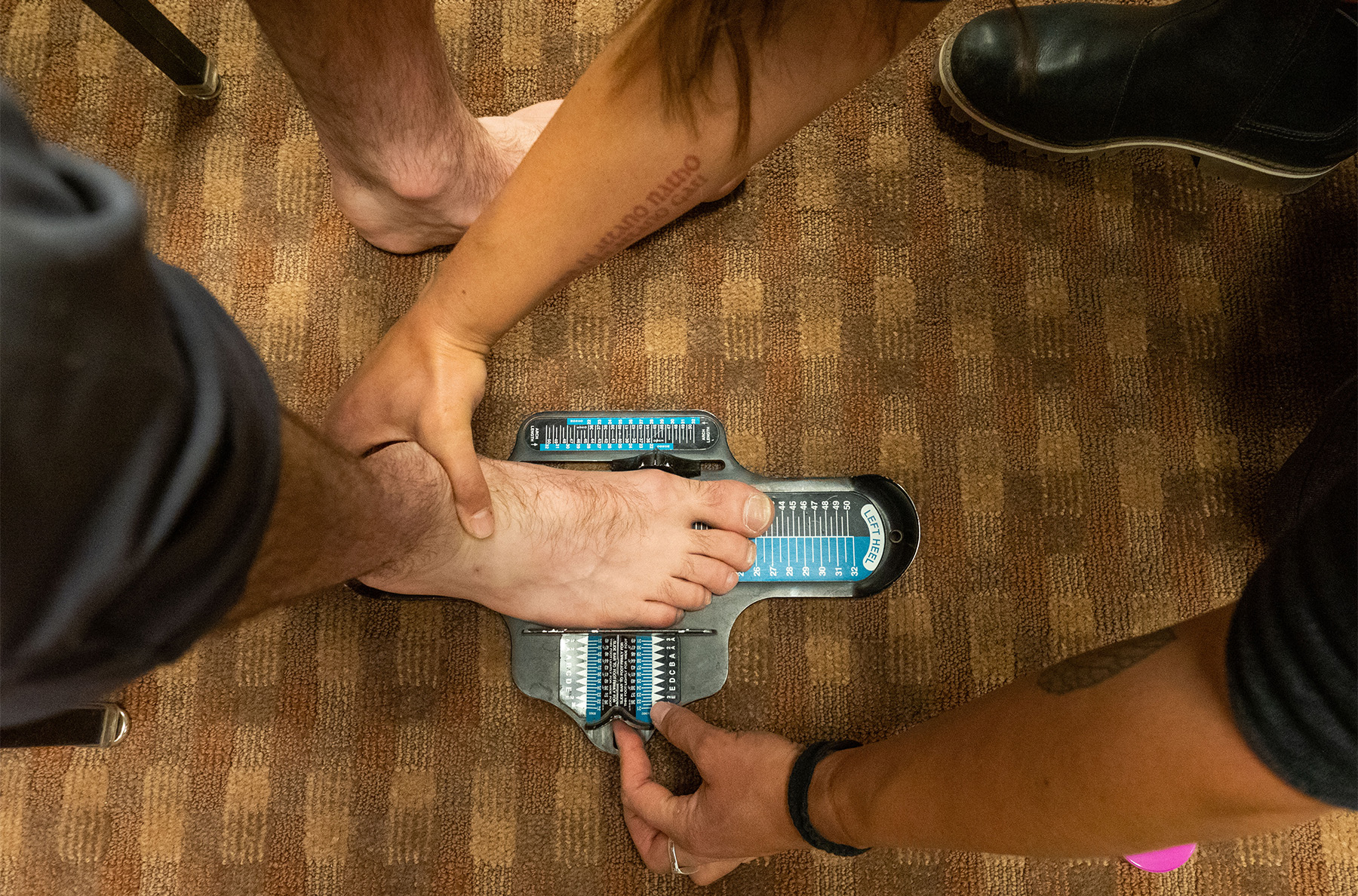
Charlie: When determining your correct size, a measuring tool made specifically for ski boot sizing should be used. If you walk into a shop and tell the bootfitter / salesperson that you are looking for ski boots, and they do not ask you to remove your shoes and socks in order to measure your feet, run — don’t walk — out of that place!
There are basically three different sizing schemes used when measuring feet: U.S. size, Euro size, and Mondopoint (or just “Mondo”) size.
Mondosize is the current default scheme for ski boots. This is simply a metric measurement in centimeters of the inside of the boot from heel to toe. A size 27.0, for example, is 27 centimeters long from the heel to the toe inside the boot. Or, if you want to get picky, you could say that the Mondosize is in millimeters (e.g., a size 27.0 is 270 mm), but since the vast majority of ski-boot manufacturers list the Mondosize in cm, we’ll stick with that.
Kara: Sizing is one of the less straightforward parts of bootfitting because it can differ from foot to foot, and personal preference plays a role. That’s a big reason why it’s not as simple as converting your preferred shoe size to a Mondosize; most “conversion” charts would often recommend a Mondosize that’s 1-2 sizes too big, if going off your preferred shoe size.
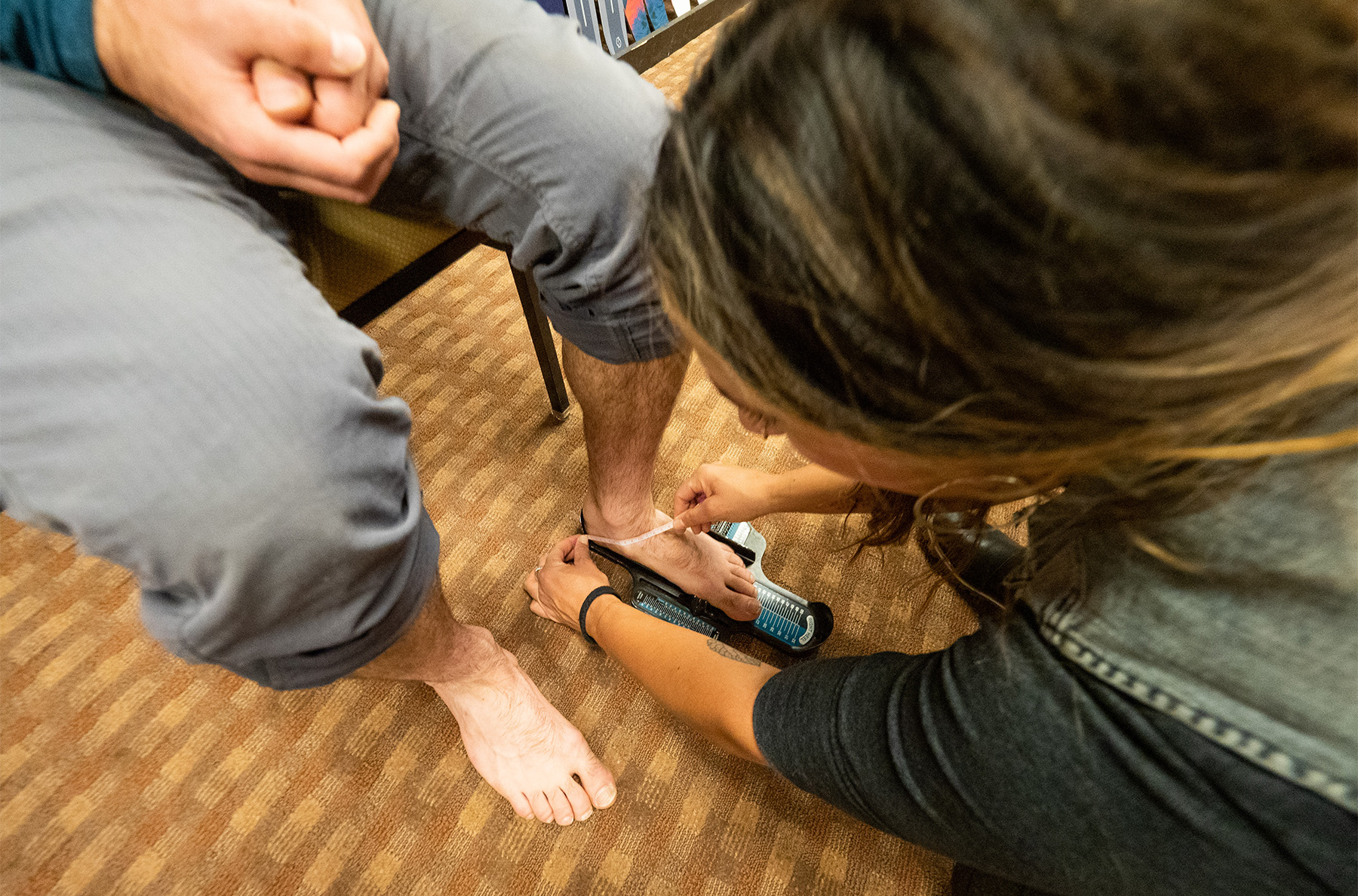
All that funny number business aside, when you sit down with a bootfitter, they will be taking more than one measurement of your foot. Traditionally, using a “Brannock” device, sizing comes down to:
- The length of your foot
- The width of your foot relative to the length
- The length of your arch relative to the length of the foot
- The volume / measured length of the instep relative to the length of the foot
- The length of your foot weighted vs. semi-weighted (or unweighted)
Most of these are pretty straightforward, but it’s worth touching on what the “instep” measurement is and why it matters.
Your instep is the part of your foot between the ball of your foot and the rounded portion of your foot that is directly in front of the ankle joint (effectively, the top of the foot). A lot of people think they have a high arch, but often what they mean is they have a high instep (and it isn’t uncommon that a high instep coincides with a high arch). If you have trouble getting in and out of shoes like cowboy boots, leather ankle boots, etc., it’s possible you have a high instep (it also definitely makes it harder to get in and out of ski boots).
In ski boots, the fit over the instep is really important for a few reasons. Firstly, this is a pretty sensitive part of the foot, so boots that are too tight in this area will quickly cause foot numbness and/or pain. You also have your cuneiform bones in this area, and footwear that is too tight on the top of the foot can cause calcification of these bones, making it more uncomfortable to be in footwear such as ski boots over time. On the other hand, if you can achieve a fit in a ski boot that is comfortably snug in this key area, then you will benefit from feeling locked and secure in the throat of the boot, which prevents movement inside the boot. By achieving a snug fit through the instep, you also gain a lot of control, since much of the motion of your skis is being generated through the ankle joint and instep area.
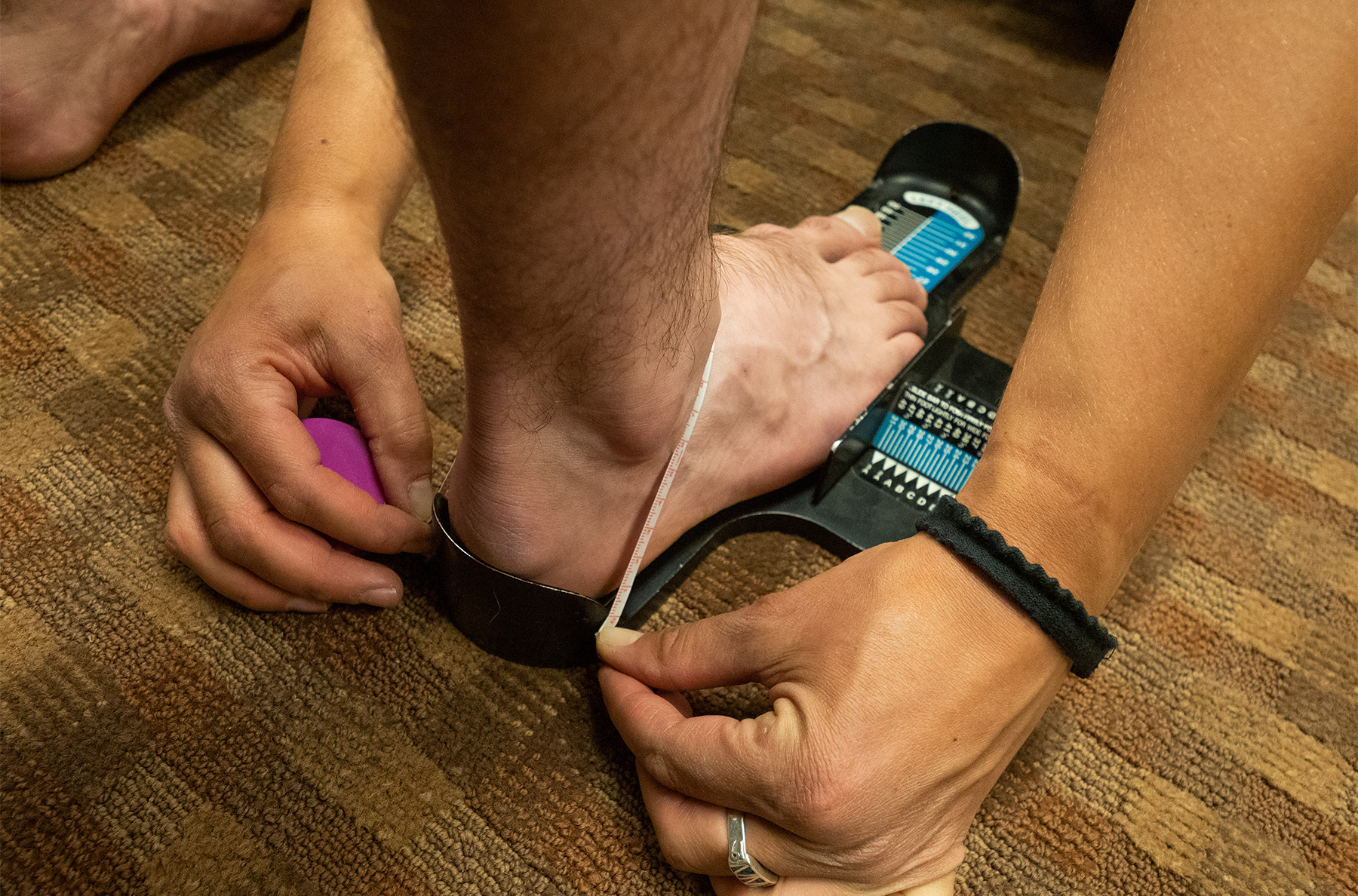
For all these reasons, the volume / height of your instep should be taken into great consideration when it comes to finding the right ski boot. You are looking for a fit that is secure but not too tight (more on this below).
In an ideal world, the instep volume / measured length will measure the same as the Mondopoint length. E.g., a 265 mm instep for a 265 mm length foot. Obviously, this isn’t always the case, in which case the bootfitter will start considering how to account for an instep / foot length disparity.
This measurement is officially called Heel Instep Perimeter or HIP. For someone whose HIP measures larger than the length of their foot, this HIP measurement will be a bigger factor in determining which size of boot you end up in.
Charlie does a great job of discussing this type of fit case in Bootifitting 101: Fit Issues and Myths.
[A note on BSL vs. Mondo numbers: There are two common stats used to describe ski boot length, but they mean different things and have different uses. The external boot sole length (“BSL”) includes the extra length of the heel and toe lugs on a ski boot, so the BSL for your correct Mondopoint size does not perfectly correlate to the actual length of your foot. E.g., the BSL for a size 26.5 boot can vary from roughly 295 mm to 310 mm, depending on its toe and heel lugs, outsole, shell-wall thickness, etc. So stick to Mondo numbers when determining fit; BSL numbers are primarily used for properly adjusting bindings to boots.]
A Dirty Little Secret: The Truth about Half Sizes
Charlie: Pretty much all ski boots are listed as being available in sizes 24.5, 25.0, 25.5, 26.0, and so on. But the thing is … there is no such thing as a half-size shell.
A 27.0 and 27.5 are the same size shell. (SCARPA’s boots are a little different: they size their shells so that the whole size and the half size smaller are the same. E.g., a 26.5 and 27 are the same shell.)
Even those who know the truth about half sizes often assume that the boot liners used in a 27.0 and a 27.5 are different. Most brands have actually moved away from half sizes, and are only listing full size jumps within the sizes they offer, so you might see them list the size as “27/27.5,” since these are the same size.
And if there is a difference in half sizes within a brand, the only likely difference between the whole and half size is the thickness of the removable insole included in the liner. (Insoles are a whole different topic; for now, listen to Ep.214 of our GEAR:30 podcast for more on why we think all skiers should be using custom insoles.)
A thicker insole is used for the whole size (27.0) and a thinner insole for the half size larger (27.5). Why is that, you ask? Pretty simply, it’s cost.
The injection molds used for making ski boots often cost upward of $100,000. There are currently 8-9 shell sizes for ski boots. That’s $800,000 – $900,000 in molds per size run, per model. There are usually 7-8 different models of boots in any given brand lineup. Since the difference between a whole and half size is 5 millimeters, boot manufacturers regard it as financially infeasible to produce an additional 8 or 9 half-size shells.
Shell Sizing
Charlie: The Brannock measuring device that was mentioned above should be used as a guide, not a rule. To confirm that the size of the boot you are trying on is correct, you can do a simple test.
Shell sizing is probably the best way to determine your correct size. Simply pull the liner out of the shell and place your foot in the shell. Move your foot to the front of the boot so that your toes are touching the end of the toe box. Bend your knee to see how much room there is between the back of your heel and the shell. An easy way to judge this is to use a 1”, ¾”, and ½” dowel.
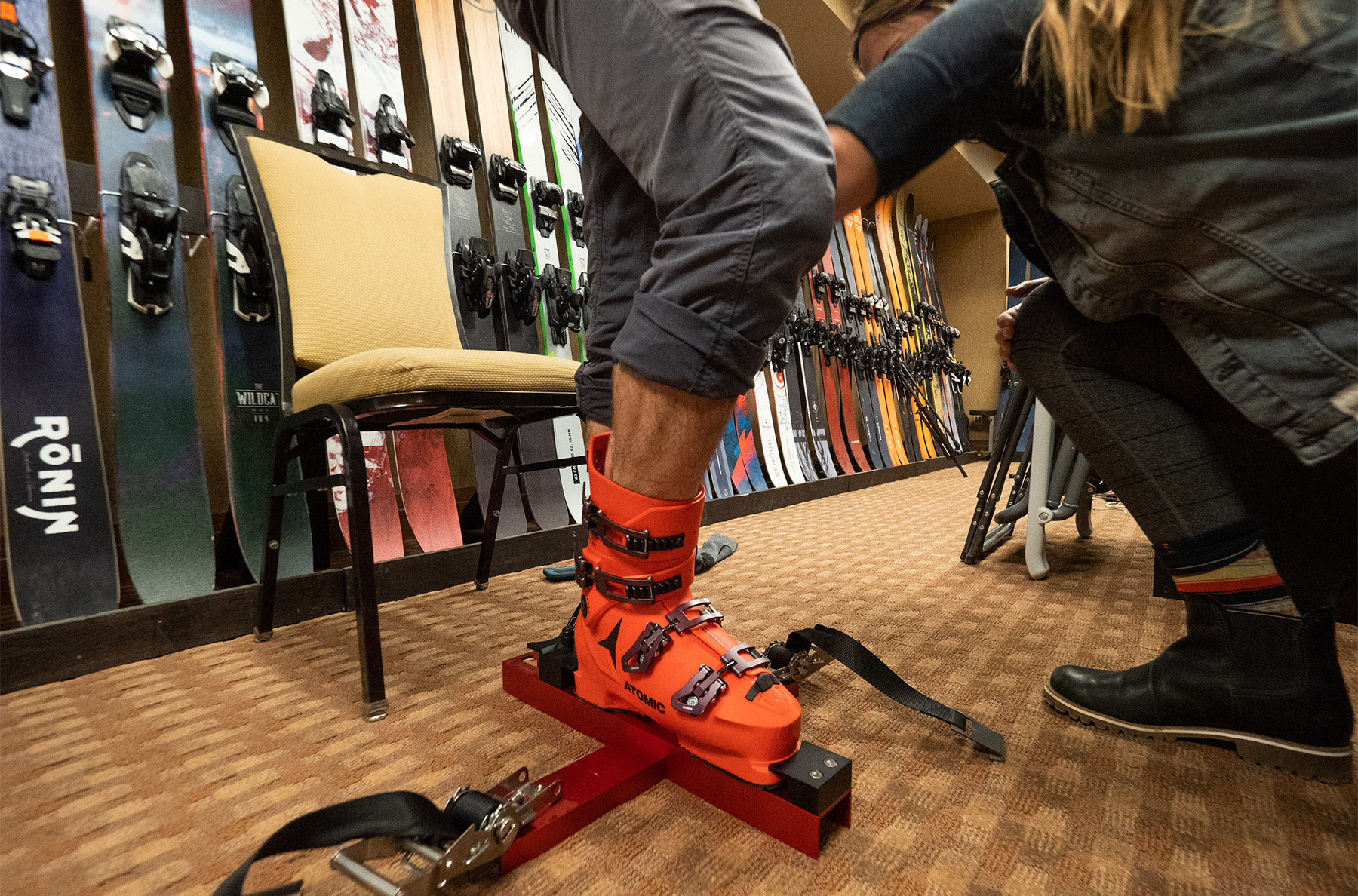
Here’s a rough breakdown of a few common shell fits and the types of skiers who might prefer them (this is all assuming the skier prefers this fit, and didn’t end up with it accidentally).
1” / 25.4 mm behind the heel would be considered a roomy fit (sometimes referred to as a “tourist” fit).
If we had to stereotype, this skier is someone who’s happy to only ski on green and blue groomed runs on sunny, warm days at very slow speeds and probably doesn’t carve their skis on edge. This person is perfectly happy to slide around with no thought for performance.
3/4” / 19.1 mm of room behind the heel is for the more avid skier.
This skier has some experience. They will ski on most trails, and sometimes the most difficult trails. These skiers are intent on improving, and often get out on the slopes for more than one trip a year.
1/2” / 12.7 mm behind the heel is for the expert / performance-focused skier.
These skiers are aggressive and demand instant reaction from their skis. They ski fast on all terrain, but likely prefer the very steepest chutes and highest-speed groomers their mountain has to offer. For them, on-snow performance takes precedent over maximum comfort.
So, what does a “good” fit actually feel like?
Most new skiers and many experienced skiers don’t know what a “good” fitting boot feels like. Out of the box, a new boot should be suspiciously snug, like a firm handshake. If you have ever offered your hand upon an introduction only to receive a loose, wet noodle from the other person, well, this is not the type of fit you want from your ski boot.
On the other hand, if you have ever had the misfortune of having your hand crushed by some Neanderthal trying to exert their dominance, then you can appreciate why this would not make for a “good” fit either.
“Suspiciously snug” means that there is a firm, even pressure around the whole foot, from the metatarsals back to the heel, and up the lower leg. Only your toes should be able to move. If the boot feels like a bedroom slipper it is too big! (Have you ever golfed or played tennis or rock climbed in bedroom slippers?)
When you first put the boot on, it should feel short.
The toes will feel a little claustrophobic at first. This is OK.
The biggest mistake a new boot buyer makes is judging the size of the boot before buckling it up and bending the ankle joint by driving the knee forward. This simple act will drive the foot rearward into the heel pocket, thereby giving the toes additional space. It’s also far more representative of how your leg and foot are positioned when actually skiing.
It is my opinion that anyone skiing in their measured size is in a size too big.
This is not to say that everyone should downsize their boots, but everyone should at least try on one size smaller to see if this is a viable option for the skiing they intend to do.
If you do decide to try on a size smaller boot, leave it on for 10 to 15 minutes, flexing and making skiing movements before you decide that it is not for you. You may be surprised.
Kara: Charlie does a great job with all these descriptions of how a new ski boot should feel. “Suspiciously snug” is the best depiction of the feel you should be looking to achieve in your brand-new ski boots.
Your toes should be “aware” of the front of the boot, even when in an athletic ski stance: ankles bent and shins pressed into the front of the boot. When standing upright, you will likely feel very aware of the front of the boot, and that’s totally okay.
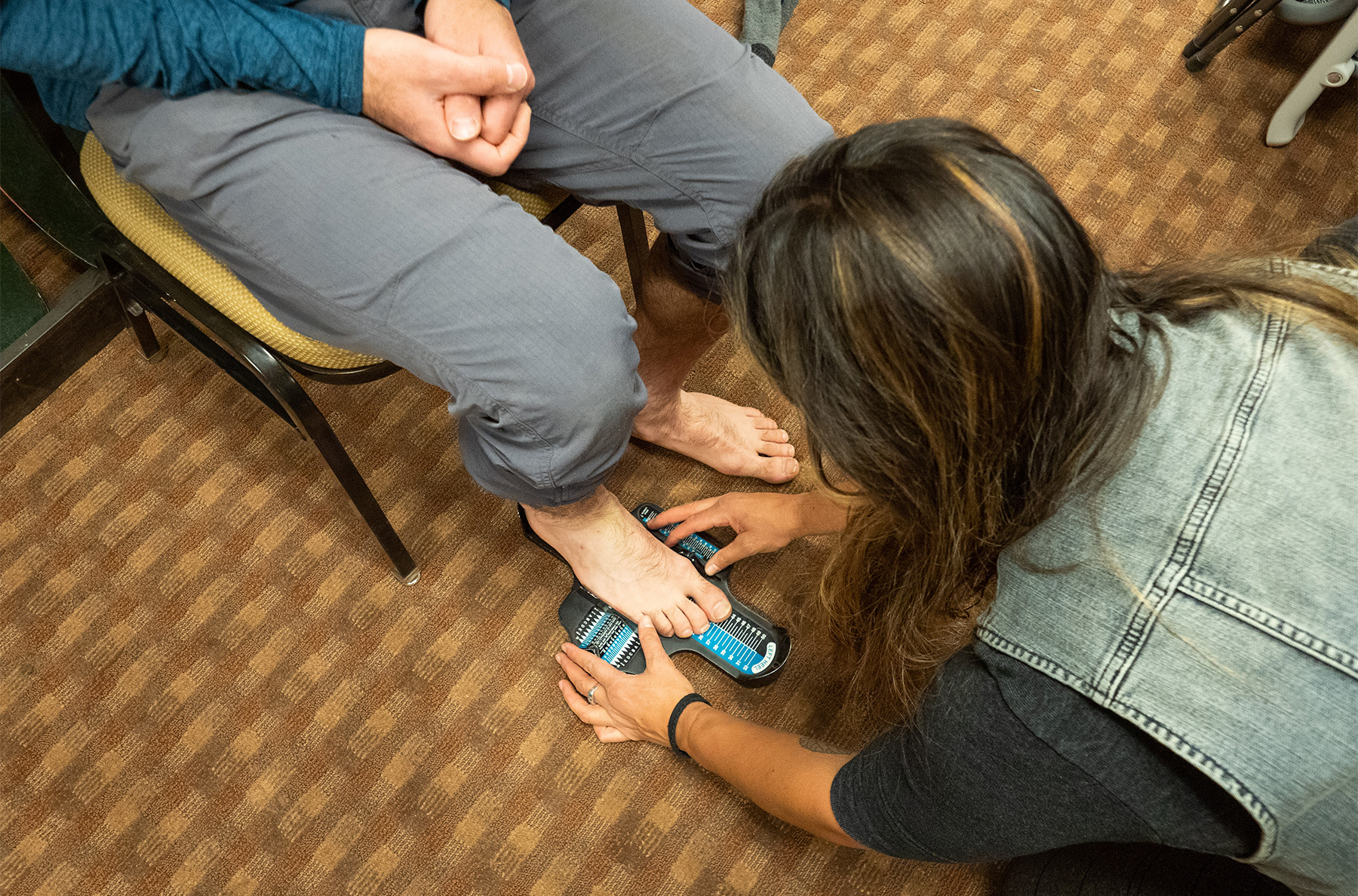
The best boot for you should feel uniformly snug, providing a firm, even pressure throughout the entirety of the foot. It’s also quite important that your heel and ankle feel really secure and locked down. Keep in mind that, due to liners compressing and “packing out” over time, the day you first put your foot into a new ski boot is typically the tightest it will ever feel.
As you are trying on boots, these are the sensations to be aware of. And while you might be acutely aware of certain pressure points or hot spots (especially if you have some of the common bony prominences pictured below), the goal is to find the boot that feels the most uniform everywhere, keeping in mind that there are measures that can be taken to improve the fit in certain areas.
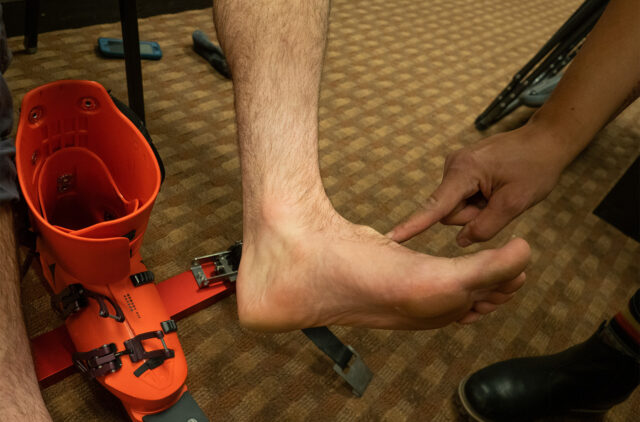
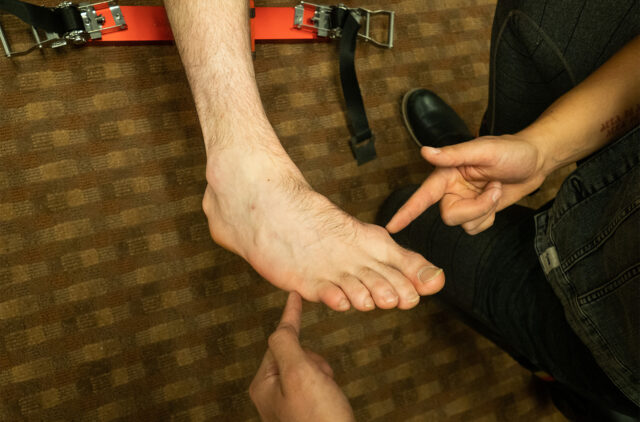
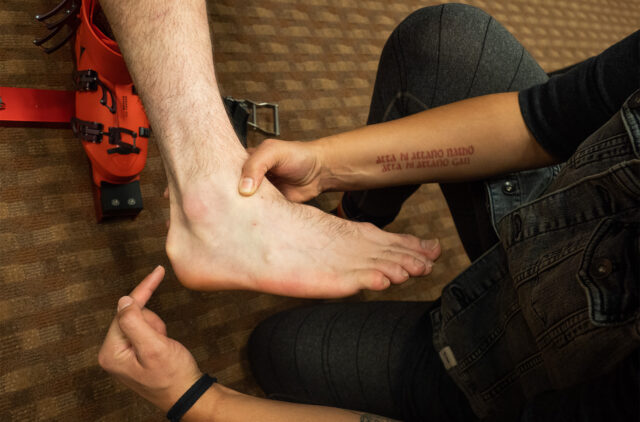
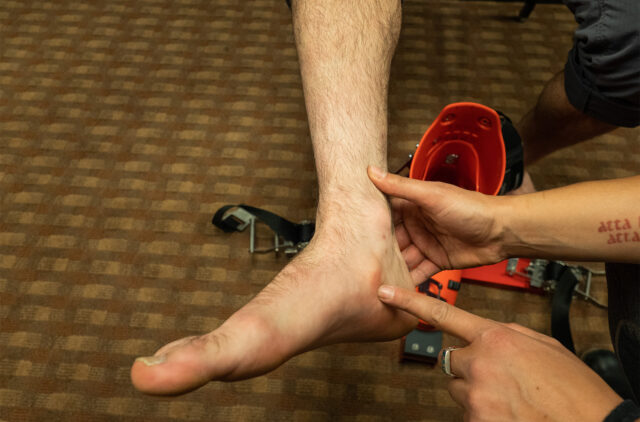
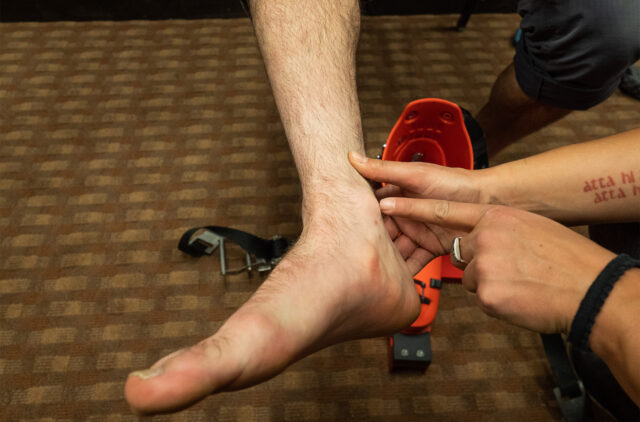
On that note, keep an eye out for our next segment, in which we’ll discuss what can be done to take an appropriately sized and selected boot from “good” to “great.”
An Aside on Ski Socks
Kara: When it comes to ski socks, while it might be counterintuitive, “thin to win” or “the thinner the better” are often the phrases you will hear bootfitters say. Not only should your socks be thin, but having a sock comprised of materials that wick moisture is also key; wool and synthetics are typically best, especially when mixed with an elastic material to achieve a uniformly tight fit, while cotton socks are far less ideal.
Thin socks are important because a well-fit ski boot will not afford you very much extra space. You really don’t want your ski sock to be taking up any additional space in a ski boot. If the purpose of a thick sock is to take up extra room, your shell and/or liner are likely too big. And if you’re cramming a thick sock into a properly fit boot, it will likely make the overall fit excessively tight and reduce circulation.
Additionally, the less friction created by socks within the boot, the better. This also means that, ideally, the only layer that is inside your ski boot is your ski sock. To reduce friction, rubbing, or uncomfortable seams, your baselayers or long johns should never be inside your ski boot. A lot of brands make ¾-length baselayer pants specifically for this purpose, but we would also go as far as to say it might just be best to cut off some of that extra material if folding them up feels too tight or uncomfortable on the leg. In a similar vein, a sock that’s too loose will be able to shift and create friction, whereas a uniformly snug sock is less likely to have the same issue.
Lastly, in an ideal world, you’d wear the ski socks you actually ski in when trying on a new boot or having bootfitting work done to your boots. Socks factor into how you perceive the overall fit of a boot, so you don’t want to be using a sock that’s drastically thicker or thinner than the ones you’ll be wearing when actually skiing in the boot.
I’ve been a professional boot fitter for quite sometime. This is a great primer. The difficulty of the boot fit lay with getting good information like this to the once-or-twice-a-year skier that doesn’t surf the net. Great primer, though.
The Atomic B series are the same as the Scarpa as well. They have a shell size that go across sizes. For instance a 23.5 with be the same shell as a 24.0
got fitted at my local shop a few years ago. just tested my boots for length by taking out the liner and stepping inside. i have about 2 inches behind my heal. whoops. the weird thing is they feel pretty snug all around when on my feet with the liner, i just have a little heal slip every once in a while. any suggestions besides taking the boots back in and asking WTF?
Great primer for those new to skiing. Hopefully other skiing resources pick up on it as I imagine the bulk of Blister’s readership is already in the know.
Here’s a 201 question: Know of any up to date databases containing data points on various boots’ last, volume, flex, etc?
As a boot fitter myself this is a great intro article that ticks all of the key boxes.
Also, love how you’ve used the same analogies (e.g. firm hand shake) that I use with my customers!
Thank you.
Excellent post! We are linkng to this great article on our website.
Keep up the good writing.
? On the liner itself, there are some numbers stamped such as “0151215-18” That is the liners size. So what size is this liner. I deal a lot with kids boots that are used and the shell size is worn off many times. So I pull out the liner to see what size they are.
Look for the boot shell length usually stamped on the heel lug of the boot. When all else fails, shell size.
at the end of last season I got a pair of BD Factor MX and I have been experiencing heel numbness. A bootfitter installed a wedge in the heel and it didn’t seem to do much. Any recommendations?
Thanks!
Heel numbness is typically a pinched nerve. Finding where the nerve is being pinched is not easy. You need to see an experienced boot fitter.
Hi, the last few seasons my pinky toes on the left foot and on the right foot numb up. Whether I’m in ski boots skiing or in boots snowboarding, it’s always the pinky toes numbing up after about 35 minutes. The rest of my feet and legs feel fine in the boots. Is there a quick remedy for numbing pinky toes, any adjustments I can do to my boots? (Vans Matlock Boa snowboarding boots and Lange Banshee ski boots)
Sorry it took so long to respond. I don’t always get notifications of comments.
Do you have custom foot beds? That would be the first thing to do.
Hi Minh, footbeds as recommended for sure,,,, another useful trick I have found is after a couple runs, going in the lodge, removing one’s boots, give your feet 5’ and put them back on. For myself and a couple others this works magic with foot comfort and warmth.
Great primer. However, your ski level characterizations are off-the-mark. East coast skiing has few steep chutes and not much powder. We’re skiing icy slopes and groomed runs more often than not. We’re still expert skiers. And it’s probably the reality for far more expert skiers than you think.
I’m not exactly sure what you’re commenting on.
Just bought a set of Dynafit Radicals for touring. Toes seem pretty squished when I’m in walk mode, not buckled. I want to make sure they are going to be comfortable all day. Any comments on length sizing when all day touring comfort is important? Seems like there won’t be as much give in the liner in that direction. Thanks
It’s kind of hard to say. Have you tried leaving them buckled? Do you have custom foot beds? How is your ankle joint range of motion?? Is there a knowledgeable boot fitter near you?
Boots are the single most important piece of the skiing. With the wrong boots or the wrong size boots, even the best ski won’t turn.
Curious, the last set of boots I purchased were a set of Heads. We did the half inch measurement and initially the boots felt ok walking around in them in the store for around 15-20 minutes. Unfortunately, I wear a size 13-14 with a size 14 instep. I ended up in a pair of 29.5s because of this 1/2 inch fitting ‘technique’ and they’ve given me nothing but problems including a neuroma, even after multiple trips to a fitter. I read in the advanced primer about volume, but it seems to me that as long as the instep is fit, and that your toes have room, it would be better to go big and have a form that’s actually fit to the foot itself, instead of cramming your foot into something smaller and hoping that you can buckle it down enough that the shell molds to your foot? Am I off in thinking this, as it seems the current recommendations aren’t really to fit the instep? Not trying to be hyper critical here, just curious. Thanks for the information in this one as well as the follow up article.
Mostly this is good advice but there are a few corrections necessary. Mondo sizing is not the length of the boot inside in cm. It is the length of your foot in cm. The inside of the boot is nearly one cm longer.
There should be no difference in fit length between Beginner, Intermediates and Experts. A good fit is a good fit and works for everyone. Downsizing from Mondo is almost certainly too small for most people except in the few boots that run long such as some Rossi, Langes and Dalbellos.
The characterization of good skiers as not spending any time on groomed is off the mark.
Definitely the boot even if sized correctly will feel small when you first put your foot in.\
Just read the next article Fit Issues and Myths and see the Brannock shown is in U.S. sizing. If measured in U.S. size yes everyone needs to downsize, but if measured in Mondo it shouldn’t be necessary.
Hi Louis,
Thank you for the correction on the mondo sizing (in the shell measurement).
A good fit is a good fit i agree, but that “good fit” will differ from individual to individual. I measure 29.5 and i ski in 27.5. This is a good fit for me, but not for 90% of skiers. I’m down sized by 2 sizes mondo, not American. Some skiers i have down sized one size. Others i have up-sized 3 sizes. It’s all based on the needs of the individual. A good boot fitter has the skills to recognize those needs. As far as what brand of ski boot can or cannot be down sized, that’s irrelevant. It’s really up to the customer to decide. If the customer is never given the choice, then no one will ever know. Each customer MUST be treated as an individual and given all the information the knowledgeable boot fitter has at his/her disposal in order for the customer to make a good decision. If i think a customer will benefit from a smaller boot, i will let them try the smaller boot on as an option and let them decide if it is right for them.
As a skiier, not a bootfitter, I have a different perspective. Since I don’t race, performance isn’t my number one concern. Lasting through the day without getting cold toes is more important. I’ve had the shell of my downhill boots punched out, and even so, 90% of the time I don’t buckle my foot. This gets me down all the blacks when resort skiing. I’ll only do the buckles if hitting double diamond runs, or want to run some moguls, but then I undo them when I’m through. Snug ankles, roomy toes. That’s what it’s about. Don’t let the retail shops tell you different.
LOL old comment but couldn’t help but respond anyway. LOLLLLLL don’t let the retail shops with professional bootfitters tell you any different. They haven’t seen hundreds of feet, you have a foot shape they HAVE NEVER SEEN and they know nothing at all; their years of experience means nothing! I’m a casual skier that skis with my boots unbuckled and you should listen to me.
I went from mondo 27 (my shoe size) to 26 and boy after staying with the boot on for 30 minutes my feet were completely numb. I really tried to stay with the ski boot on for 1 hour but after 45 minutes had to take them off. Length was right but sides were killing. You mentioned firm handshake but this was like someone was squeezing my foot with the door really.
I went then to 27 which is also my shoe size and the boot fit as a sock in most parts except the toes where i had bit room in front. I personally cannot imagine lasting on the slopes for the whole day if the boots are causing too much pain but that is just me. I think the point you might be missing is that in theory the mondo size takes into consideration not only the length but also the width of the foot. From wiki: “It is based on the mean foot length and width for which the shoe is suitable, measured in millimetres. A shoe size of 280/110 indicates a mean foot length of 280 millimetres (11 in) and width of 110 millimetres (4.3 in).Because Mondopoint also takes the foot width into account, it allows for better fitting than most other systems.” That is the reason why i think most of us should stick with our mondo and not scale down. Unless one has very thin feet :)
Being from Iowa, we only get to ski once a year for 5 – 6 days… I love my Lange 24.5 size boots except for the fact a couple of years in a row my two big toes get bruised going down chutes and through the trees and my toe nails end up turning black and falling off later in the summer… ick. Are they too large/long causing a shift of my foot in the boot or ??? I’m buying new boots this year but not sure what direction to take.
This is common with many skiers who are in boots too long. The mechanism of injury is typically when the skier is thrown into the back seat usually in tougher terrain. This forces the foot forward slamming the toe into the front of the boot. I think you should at least try on the 23.5 and feel for yourself if it’s right for you. The closer the fit the less likely you will impact the front of the boot.
I had this happen in boots that are too small. First gen Garmont Radium. My foot measures 26.7 cm , my last Garmont (Mega Rides) were 27.0 so I went with 26.5 in the Radium (next shell size down). That was a mistake. Can’t move my toes, can’t even really get them to flatten out. Thought it was just because I wasn’t leaning aggressively like I ski, but after the first day of touring, my big toe nail went black. Can’t keep the forefoot buckled without significant pain. And while the 26.5 should have fit me in theory, I’ve read over on Wildsnow that the first gen Radiums were abnormally small in toe volume and people often sizing that boot up. Wish I’d know that before I bought them. I’m about to drop some $$ on Scarpa Freedom SLs in 26.5, hope I have better luck.
The thing about scarpa sizing that most people don’t know is it breaks differently than all other Ski boot companies. With scarpa the 26.5 and 27 are the same size. You’re right about the radium. They were miss-sized. If you measure 26.5/27 the freedom 27 shell will be fine.
It sounds to me like your toes are encountering the front of the boot with some force. There could be several factors involved, one of which is boots that are overly large and not holding your foot stable, so your foot can slide forward on the inside slamming into both the end of the boot and the top where it curves down to the end. Adversely a boot that is on the edge of being too small could also impact your toes anytime skiing becomes more demanding and your balance may shift back. However with either situation stabilizing your foot inside the boot to keep your toes from moving forward and impacting the front is necessary. Setting whatever the boot size is apart, Custom footbeds do help in stabilizing your foot inside the boot. If you do not have custom footbeds you may wish to plan them into your new boot budget. One last thought is that some years ago Lange had a practice of making the liners smaller than the inside of the shell, many boot fitters were opening up the ends of those liners and patching in new material to extend the toe box of the liner to meet the interior length of the shell. This practice provided extra toe room and comfort for boots being sized down for a performance fit.
remember any good boot fitter can make a boot one size bigger.
you can never make a bigger boot smaller
Great information!
Not everyone can get to a ski shop/fitter to purchase boots, I am in rural SD.
I have buddies in CO and will be skiing there mostly.
I am a beginner- intermediate level rec somewhat assertive skier
Tired of rental boots/skis I am buying my own.
Question…I am a 28 length (socks off & weighted) and a 28 volume foot
I can only find the Salomon Xpro 100 boot in 27.5 and 28.5
Leaning toward the 27.5 due to liking to move/carve but wondering on your thoughts.
Maybe the 28.5 (US10.5) can be adjusted plenty for a confident fit?
I wear a 10.5 US in all my shoes
Thank you for any assistance!
Brian
Salomon tends to fit big. The xpro is the wider boot. I think the 27.5 would be fine. But if you have a narrow foot the xmax may be a better choice.
Great article! But I’m still on the fence with the sizing down idea.
My foot measures 27.5cm with 99mm last and I tried a pair of 26.5 2013 Lange XT 100’s (last=97mm) with thin ski socks. At first it felt doable; then after 5-10 minutes, pain ensued. I removed the liners and just wore those for about 20-30 minutes. My feet were in pain with just the liners – felt pain and tingling. The toes were pressed and sides squeezed. When I took them off, the outside edges of both feet by the 5th metatarsals were red. I couldn’t imagine putting them on again.
Would boots like this have been a candidate for a boot fitter to modify or, based on the pain, not so much?
When you size down, do you size down both the length and last, or just the length?
Thanks!
As I have stated in the article, down sizing isn’t for everyone. Some can go down two shell sizes and be comfortable, others can go one smaller. But most people can only ski their measured size. It’s up to you and what works for you. A skilled boot fitter can help you make that decision, but in the end, it’s your decision. The decision to down size should NOT be made based upon the boot fitter’s ability to make modifications in order for it to work. If it’s painful, don’t do it.
I am currently trying on Scarpa Freedom SL 120 boots, which come with Intuition Cross Fit Speed Ride liners. I’m working with two sizes – 29.5 and 30. The shell appears to be the correct fit.
The 29.5 is tight, but would likely be the right size with one exception – I feel uncomfortable pressure across the top of my instep, even with the buckle as loose as possible. My question is whether the heat molding process can add some space across the top of my instep? Or is it preferable to go with the larger size and attempt to tighten the fit with the liner in the size 30?
I do have footbeds in the liners. I would prefer to keep the footbeds if I can correct the pressure point from the top of my instep. I will definitely see a boot fitter to have the liners cooked. I live in a state with no boot fitters, so very difficult to try on / size boots. My previous boots were Garmont Endorphines, but are over 10 years old.
Thanks.
Scarpa shell sizes are different than all other brands where typically the half size shell accommodates the whole size below it ie 29/29.5 is the same shell. With scarpa the 29.5/30 is the same shell. As far as your instep issue, I really couldn’t say without actually measuring. If the pressure is unbearable then I doubt heat molding the liner will be enough to make it comfortable. You might want to try the Lange free tour as an alternative.
Thanks for the quick feedback. I haven’t tried the Lange, but according to their specs, that looks to be a narrower, lower volume boot than the Scarpa. I’ll keep working on this, but thanks again for the info.
Great info, I wish I’ve read it couple of months ago :(
I bought Dalbello Krypton Fusion’s in 28 size. I’m also measured 28 and fit in the store was… not comfortable. After 10 minutes or so my 5th metatarsal area started hurting. Shell fit on Dalbellos was fine and just for reference, I considered Lange RS110 wide and those were great except too wide in the toe box. I thought that’s because Intuition liner being denser than what I’m used to. Fitter fixed me with custom fotbeds and did liner heat molding too. That seemed to improve heel hold (which was pretty good to start with) and a bit of pain I mentioned. Fitter also said I’ll have slight discomfort first couple of days too until foam completely breaks in. Skied 5 days so far and pain is not gone but decreased and I hope it will disappear completely soon. However, a bit of dead space developed on top of my right foot, mid metatarsal bones to toes. Cant lift heel or instep, its more of a toe scrunch. Side to side I’m still secured. I can get read of it if I tighten that weird reversed front buckle which does not seem to mess with the width but reduces this volume somehow. Maybe it’s something about cabrio boots, don’t know. Feet are measured identical pretty much, shell fit was good according to the boot fitter. Only difference is I probate a bit with right foot which he told me and I’m sure took into account when creating foot beds. My question is, do you still think I should’ve sized down and that boots will brake in and be loose? Also, Is it OK that I use front buckle to get rid of this dead space? I never used to buckle those before and was thought that they are there only to keep snow out, not to alter the fit.
BR
My biggest advice to anyone boot fitting is to try sizing down in length but don’t size down more than 1mm for the last of the boot or vise versa. I used to use the atomic hawx 100 but was losing circulation in my right foot and had to take it off every hour to gain feeling back. I have since switched to an even smaller boot but the fit is so much more comfortable and feels more responsive as well due to the last being almost perfect at 99 while my foot is at 100 on the nose. Great advice for first time buying boots btw, you are clearly very knowledgeable and want to help others!
Thank you. I try to help skiers keep an open mind about sizing. Too many fitters try to railroad customers into what they think is right for the customer without giving options.
Cheers!
I have two different sized feet, a 5 and a 7.5. Can you recommend a way to approach this without buying two pairs of boots? Could I possibly purchase a brand that has a large size range in it’s shell and use liners and other orthotics or additions to fill out the smaller boot?
I have a right foot that is 26.8 cm and a left foot that is 27.6 cm. Use light
Smartwool socks. In Dynafit “one” boot 27/27.5 with a 27.5 10 mm Palau liner and no orthotic the right foot is perfect and the left foot has cramped length. With 28.5 Scarpa/intuition liner medium volume with orthotic my left foot is perfect, the right foot works with a thicker sock. My solution is to use the Scarpa/intuition 28.5 liner on my left foot and the Palau 27.5 on my right foot. I am keeping my options open, as the liners pack down I will increase the thickness of my socks, add thickness under the liners and use thicker orthotics. I have never found a perfect solution for my blisters but this is where I am at 12/2018.
Just saw this. Am currently very happy with Palau 27.5 liners, Dynafit “one” boot 27/27.5, and size 12 orthotics cut down to fit my feet (using Archmold orthotics) on both feet. I also am very careful how i put on my boots. I am so happy i bought an extra pair of boots in case Dynafit changes their last (Mercurys this time). Got both of these used.
Good read, thanks!
I’ve been in Lange SX 120’s in a size 29.5 for the last few years. The boot’s have been very comfortable for me, but now I’m thinking I need a little stiffer and perhaps a little tighter fit. I just bought a pair of Lange RX130’s (similar to the SX shell, but a 100mm last instead of the 102mm of the SX) but I’m wondering if I should look at the 28.5 I’ve just worn these around the house a few times, and the company I ordered them from has a great return policy so I could easily swap them out. I do feel like a have a little extra room at the end of my toes, but haven’t had any problems from it. Problem is: None of my local shops stock the RX 130, so I’d have to order it without having tried it on. Thoughts?
My first question is how do you know your size is 29.5?? Did a boot fitter measure your foot? Remember that the Mondo point measurement is just a guide to the right size. For instance my foot measures 29 but I ski in 27.5 rx130 lv. I had a customer yesterday who measured 27.5 length and 29.5 around the instep and he fit in tecnica mach1 130 HV 28.5 comfortably and the 27.5 was too small. I can’t tell you which boot or size to pick since I can’t see your foot. Size is relative to the preference of fit tension of the skier. The fact that you went from the SX to the RX tells me the SX was probably too high volume for you.
Good luck.
Hi. Great article. I recently tried on a bunch of boots, and I really like the feel of the Atomic Hawx XTD 120. The size 29.5 felt nice actually, much more firm than the loose and sloppy fit I am used to, but surprisingly comfortable. Except in two places. Over my prominent bunions (metatarsal bump?) and in front of my big toe. Standing up straight, my big toe crunches against the front of the liner. Moderately flexing the boot, my big toe does not touch the front of the boot. Other than that…great fit? My questions:
1) How much can I expect the Atomic memory fit to stretch? By baking the shells and liners, can I expect to gain appreciable width? What about length? Can the memory fit process make the boots longer, if only a little bit?
2) If the memory fit process can not make the boots longer, is there any way to do a punch just for my big toe? I expect a punch on the side of the boot for my bunion would be no problem, but what about right at the front of the boot?
All the best,
Hi Bruno!
Sounds like the length is perfect! Don’t stand up straight in your boots. I would NOT put the boots in the oven for bunions as it will affect the fit of the whole boot. Go to a boot fitter and have him/her do point specific stretch for each bunion.
Cheers!!
Hi I’m looking to order a ski boot for some long mostly flattish traverses I’m looking at the dynafit PDG2. I run a size 12 on all my shoes (30 mondo), but have a 28.5 Scott cosmos. I get the idea of downsizing for better performance but I care more about warmth and comfort for this circumstance. Plus I’d like to throw in a thicker intuition liner for added warmth (pro tour medium or high volume). Wondering if I should go with a size 29 or even a size 30? Thoughts?
Hey Sean. Prepare for disappointment if you go size 30 mondo – it will be too big and you will get nasty heel blisters. 29 mondo might work. so you are probably looking at size 28 or 29 in your Dynafit. Dynafit PDG shells are the same 28.5 = 28, 29.5 = 29. what i would do is buy both shell sizes and then sell the one that did not fit, another option is to see a boot fitter who has some sort of no nonsense guarantee. if i was going to guess, you would do best with the same size as your Scott cosmos, but you did not mention how they fit.
Hey Sean. Prepare for disappointment if you go size 30 mondo – it will be too big and you will get nasty heel blisters. 29 mondo might work. so you are probably looking at size 28 or 29 in your Dynafit. Dynafit PDG shells are the same 28.5 = 28, 29.5 = 29. what i would do is buy both shell sizes and then sell the one that did not fit, another option is to see a boot fitter who has some sort of no nonsense guarantee. if i was going to guess, you would do best with the same size as your Scott cosmos, but you did not mention how they fit.
I’m looking to replace Salomon X Pro 120 28.5 boots. These boots fit me fine. The fitters did extensive punching to make them fit. I measure 29.3 cm long for right foot, 111 mm wide. Left foot is 28.5 cm long, same width. Measuring my instep from heel over the instep to other side of heel is slightly more than my foot length which I believe means I have a somewhat high instep. I have a Sidas custom foot bed.
Recently I purchased the Salomon S Pro 120. My fitter recommended I purchase 27.5, pretty much based on how much space my bare foot had in the shell. After numerous sessions of punching these boots out, the shell cracked on the right foot. The boots are being returned under warranty. I would say that while skiing these smaller boots, I did experience a feeling of better edge to edge performance. But my toes were pinched and always cold.
Now we are looking at Lange LX 120. Again the fitter says 27.5 is the right size. I tried on the 27.5 without my foot bed. Right foot hits the toe on shell when upright, not when flexing forward. Toe box seems a bit bigger and instep OK, as the specs for this boot would indicate. They didn’t have a 28.5 for me to try so I couldn’t compare.
Does it seem reasonable that I could be comfortable in a 27.5 Lange LX 120? I ski 80 days a year and certainly value performance, but value comfort more.
Thanks.
Let me suggest something. Measure your foot length with your foot on the orthotic. Seems to me with a high arch and an orthotic your foot length is going to shrink versus barefoot. There is a chance that will clear things up. Since you have a custom foot bed, assuming it fits, you could even measure the length of the foot bed. But in any case, if your boot fitter has a guarantee and a good reputation, odds are you should go with the boot fitter’s advice.
Thanks for your quick response!
My right foot measures just a hair over 29 cm when standing on the foot bed. On the right foot, my big toe is slightly longer than the foot bed. I think my fitter has a good reputation and they do guarantee their fit. So I’ll likely give them another shot depending on how initial fit feels with my foot bed. I’m assuming from your response that it is not unrealistic to fit my size foot into a 27.5 shell designed for higher volume feet.
I just skied with rentals sized 25 (women). My US shoe size is 8 and EUR size 39 (in the left foot, right foot is 38). My foot length is 24 cm, in step 24 cm as well. I felt great in the rentals. Came home, tried on Salomon Quest Access 50 that someone gifted us a while back, in size 26.5 and they felt even better. I was more snug in some areas but less in the toes than the rentals. I realize I haven’t skied with them yet but considering that the general recommendation is to go one size down, I am wondering if I could actually ski well with them. I’d like to buy my gear but I am in a rural area so best option is online for me.
sounds like your fitter is trying to achieve a performance fit. if what you want is a comfort fit, then a 27.5 is going to be more work to get you comfortable than a 28.5. Maybe a communication problem?
Bill really appreciate your help. I made sure we all understood that comfort was more important than performance. Went ahead with the 27.5 size Lange LX 120. With a bit of punching, I now have a good fitting pair of boots. The Lange LX 120 worked for me because it accommodates a higher instep plus has a wider starting width. I cannot perceive any performance loss from the Salomon S Pro which we couldn’t make fit.
Garmont Radium…shell size “27/28.5’…mondo bare foot = 27.. w/2″heel to shell….due to cold injury toes lose circulation with stock liners …going to buy Intuitions…their recommendation…Pro Tour high volume size 28..
Does that make sense? How do your determine which volume liner to use? Superfeet insoles recommended? [no boot fitters within 300 miles]
Thanks…
Frost bite sucks! That’s permanent loss of circulation in the toes. I would opt for hotronic foot warmer as a solution to prevent it from happening again. Intuition is great for insulation but without circulation…that’s like having a well-insulated house and never turning the heat on. Eventually, it gets cold. I don’t know if going a size bigger is going to help. You’re gonna have to buckle down more which could also reduce circulation. They recommend the high volume to accommodate the larger boot size to help take up space.
A custom insole will always make a boot fit better.
Cheers
Hey Charlie
Thanks for a great original article and for sticking with it and answering all these questions over the years. You are a true pro! I’ve got a bit of a story and a couple of questions: bought a pair of Nordica Speed Machines in Chamonix in 2009. Fantastic boots, got the liner heat molded and all that. The pro said I should size down and I took a 27.5 (I’m a 10.5 US). The first day they were agony as I broke them in but the pro explained that my feet should not spread out flat, they should be gripped tight so that they remain clenched like a cupped paw for better control. First question – is this correct? I stuck it out and had the shells expanded when I got back to the States and after a while the boots softened a bit and so long as I kick my heels right to the back of the boot they are OK – good for control but never exactly comfortable. When it is cold esp on East Coast I get numb toes in under an hour. The other day I tried a pair of rentals size 28 and they were such a breath of fresh air – no numb toes! So, question #2: can I take the liners out of my old Nordicas and put them in a size 28 shell? Should I even bother? Final Q, the new boots I tried were a standard Head pair – what other brands have a similar fit profile to Head? Thanks in advance
How much is possible to widen a boot? I’ve got a 105mm wide foot and are choosing in between Technica Mach1 MW (100mm) or HW (103mm). The latter might even work straight out of the box. But i guess it’s better to buy a bit to small and widen them if needed.
Hello, I have the same question as Dan! How much is it possible to widen a boot?
My feet measure 107 (quite wide). The typical wide boot comes at around 102-103, which I assume would work, but could I get a medium-wide boot (100) and be able to widen to be comfortable? That would drastically increase my purchase options.
Thanks!
This is such a well written article. All those great information and explanations. Great additions Kara, I just love that open minded MFU approach of bootfitting. Great job and props from a fellow MFU bootfitter. Cheers.
Hey guys,
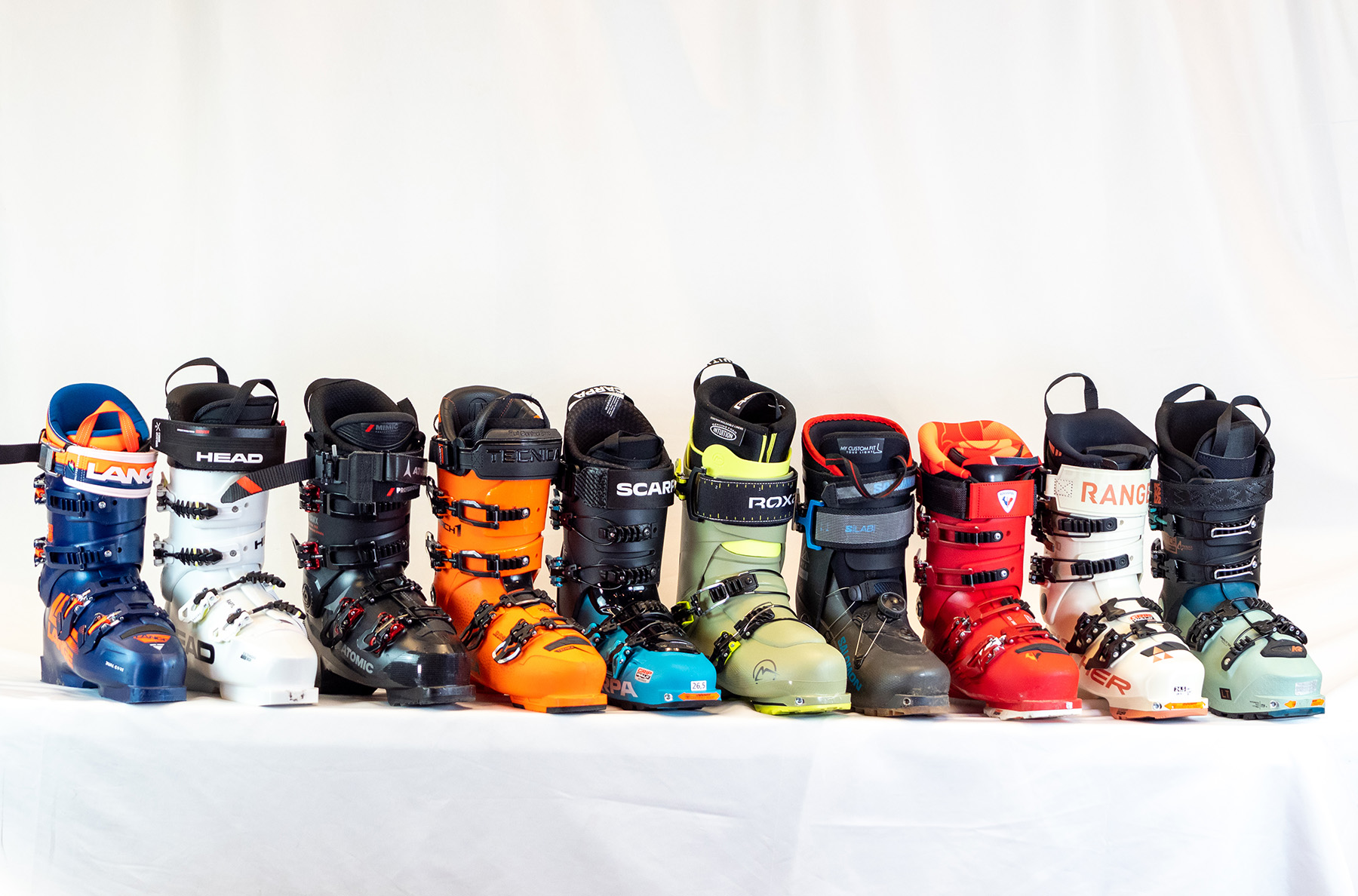
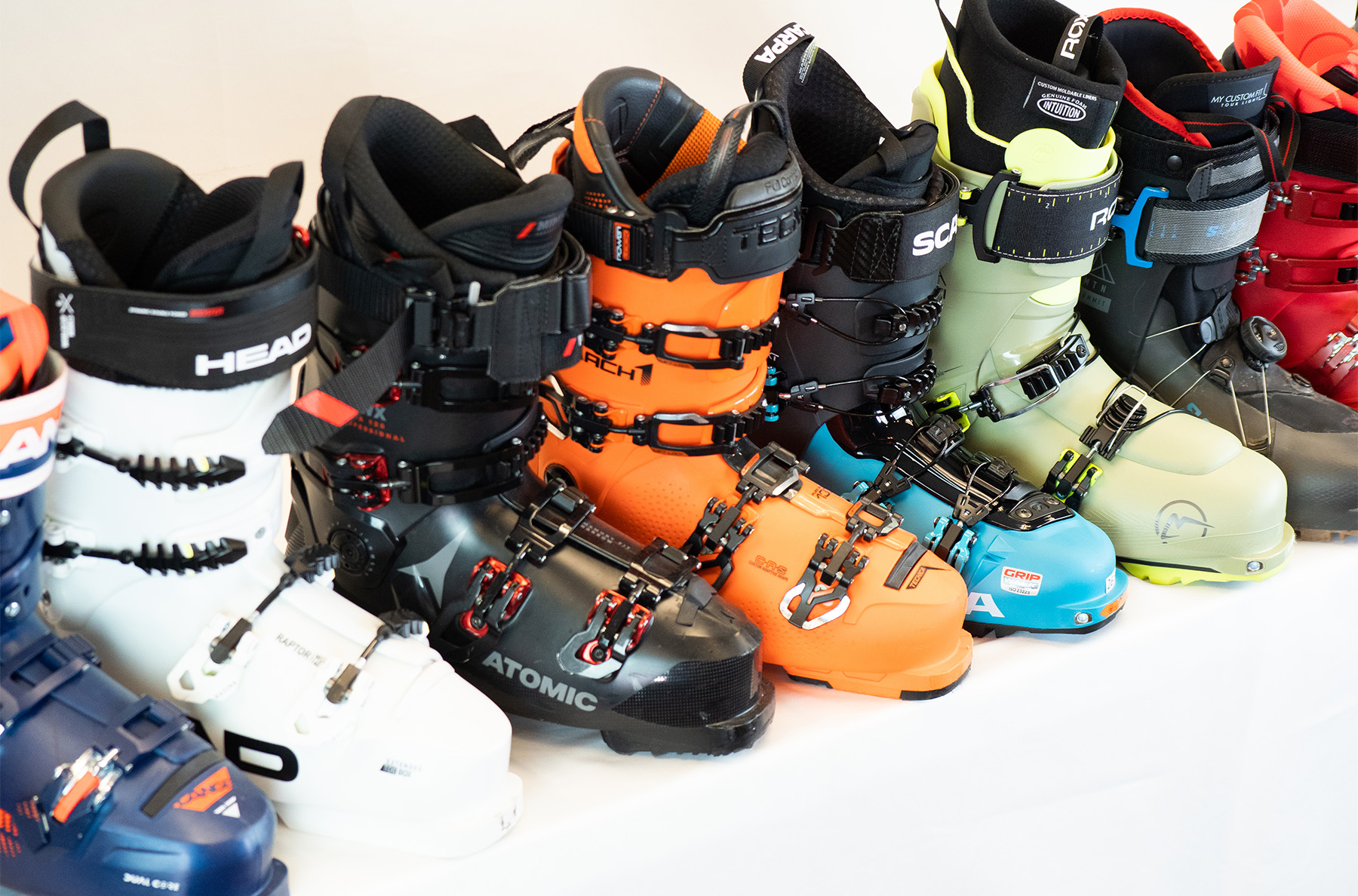
The first thing I noticed was your pic of all the boots lined up and the difference in cuff height. I wonder if it’s something worth showing for future your boot reviews ? Have a common boot model as a benchmark and the boot being reviewed beside it ? I just saying that as the Roxa in the photo was surprising how tall it was.
Keep up the good work
Really good article in general. Lots of good advice and discussion in the comments. I bought two new ski boots recently and for the first time in almost 40 years of skiing got a proper fit. Old biases were holding me back and I think they are still present to a degree in this article. I applied my mechanical engineering skills to my recent boot fitting experiences and I am now a big proponent of evolving ski boot purchasing beyond the information in this article. Old biases/approaches need to be eliminated. This may be long, but I think its important to re-educate the skiing world on the strategy for ski boot purchasing. Here are my thoughts:
#1 Important piece of information is ski boot widths (last) go up and down with ski boot length. In the past the only way to get a narrower boot was to drop to a smaller size. NOT true anymore. Boots come in up to 5 different widths these days depending on brand and type.
#2 Important piece of information is ski boots should NOT be viewed as “un-modifiable” or like shoes. Its just the opposite, look at ski boots as they should require work or “mods” when purchasing or your not getting your best fit in most cases. Most people go in with the attitude they have to find a boot that when tried on, it fits the best, meaning out of the box. Wrong, you want the boot that will fit you the best “after modifications” which will be done at the shop before you leave. Hence buying over the internet changes the “modification” dynamic for the worse.
#3 Important piece of information is the options for fit by ski boot selection are length (size), width (Wide, Medium, Narrow, Race Narrow, Plug Race Narrow), Liner volume (aftermarket liner), Heat molding to locally expand the boot, footbed thickness, and tongue thickness. In the same size boot, you can choose the last size (width) to fit the narrowest part of your foot and then heat mold the boot to expand where needed. There are limits of how much expansion, of course. Heat molding allows for a narrower boot to work for wider feet or feet that vary in width between heel, ankle, and forefoot.
#4 Important piece of information is I believe you should choose the boot size with a proper length for your toes. Who wants toe pain and black toenails after skiing. Proper length is somewhat personal, but I don’t want my toes to touch the end of my boot ever. Once a long enough shell is found (don’t go too long, either) then figure out what width you need to get “significantly snug” fit in your heel, ankle, instep, and fore foot. You should have wiggle room in your toes. Change the tongue to adjust instep fit.
#5 Expect to feel discomfort or pain initially, until the bootfitter has made all the necessary modifications. If you don’t, you are probably in too large a boot. Its very important to sort out any discomfort or pain by what the solution is with the bootfitter. Some issues may require a different length/width or shape boot, when all issues can be solved by “modification” (punch, grind, heatmold, padding) you have probably found your boot.
Its real important to identify your foot type with the fitter, as different foot types require different approaches or strategies to get a good fit. I won’t go into the details here, but the article below by Charlie Bradley is a very good start down that path.
https://blisterreview.com/gear-101/boot-fitting-101/fit-issues-and-myths
Measuring the Foot: Length AND Volume
It’s easy to put a foot on a brannock-style measuring device and come up with the allegedly “correct” size. But there is more to it than that.
I’m getting setup for AT for the first time ever. Would I be wrong to assume that the Atomic Hawk Ultra XTD version is a safe bet since I’ve skied the regular version inbounds for years, successfully? What about sizing for AT… if I were to stick with that boot, should I size up for climbing?
This is an Alpine boot with a tour features. So same rule apply. A good insole will help hold the foot from moving “sliding” fore and aft.. the Hawx XTD is better at Skiing heavier on the climb. Make sure to get the Mimic liner molded very important. Then mold the shell . This will mold the cuff to your leg. There is no other way to align the cuff to your lower shaft.
I used this logic when gearing myself up for AT over the last couple of seasons. I ski Atomic Hawx Ultra 110 W (24.5, 2018) and bought a used pair of Ultra XTD 90 W (same size, same year) to try touring. My setup has been minimally tested (with climbs of <2hrs), but I have had no fit issues whatsoever. The only change I made was to use my non-XTD insoles in the used XTD shells (likely unnecessary had I bought new).
Can anyone tell me if the new K2 Flex boot is an exact copy of Raichle/ Dropkick boot ? I have contacted K2 but they don’t reply.
I always suffered from really bad shin bang until I got into this boot.
Listening to the bode miller podcast also reassured me I’m not missing anything in lateral strength by being in this boot.
I have skied all my life and I love to carve! I love starting with quick, sharp turns and progress into long fast hard carving GS turns until my legs burn. About 15 yrs ago, I was fitted for a Lange (surefoot) high performance boot, I believe it has a 140 flex rating. I have a high instep and never buckle the bottom 2 buckles, my toes fall asleep almost instantly even without the bottom 2 buckled. I stiff drive these boots as I really like their performance.
My question is am I losing performance/feel/fun when I go off into the trees? Would a boot with less flex enable me to further enjoy a day after a good dump into the trees?
What flex would be recommended if I bought boots primarily for powder skiing? Do diehards own different boots for different conditions (like skis) ????
Thanks guys!
I am renting ski boots and wore them for the first time the other night and my feet went numb and became painful. I am assuming this is because they are too tight? The rental shop has the next size up but when I try the next size up on the length feels fine but it seems liek the width is pretty big and i can move my heel up and down when i walk. Is it better to get the larger size or the too small size if these are my only options?
I have neuropathy in both feet (numbness of the toes primarily and occasionally pain). I have been using older Dalbello Boss 110 in size 28.5 since before the neuropathy started. Even back then my toes would get numb after skiing 1.5 to 2 hours. Also the boots have always been hard as hell to get on and take off. I have to heat them to have any chance of getting them on. Any thoughts on moving to 29.5 with the current model of these boots? By the way, this was a great article.