

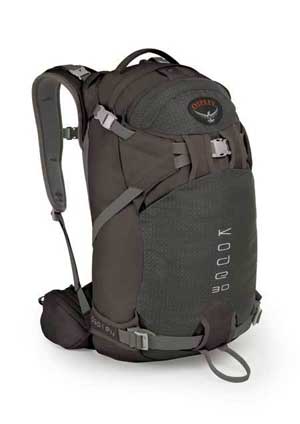
 Osprey Kode 30
Size: Small
Volume: 27 L / 1648 cu. in.
Weight: 2 lbs, 15 oz / 1.34 kg
Dimensions (height x width x depth): Inches: 21.5 x 13 x 12; cm: 55 x 33 x 30
FEATURES:
- A-frame ski Carry
- Avalanche Gear Compartment/Dry Clothes Carry Compartment
- Diagonal Ski Carry
- Goggle pocket
- Helmet Carry
- Hipbelt Pockets
- Ice-ax Carry
- Insulated hydration sleeve
- Snowboard Carry
- Vertical Ski Carry
MSRP: $139
Kate Hourian gave us a great review of the Osprey Kode 30 in her first look and expressed how it is one of the most comfortable, versatile, and organized backcountry ski backpacks on the market. I couldn’t agree more with Kate, having owned two versions of it over the last four years. Yet there are a few features of this pack that are worth discussing further, as well as a few things that Osprey could potentially improve.
I bought the Osprey Kode in its original incarnation in 2007 just before a year abroad in Chile. I used it all over the Andes as a summer and winter backpack. I loved the first version, and I love the second one even more. I used the old version of the Kode for more days than I can count, and I’ve put in more than 60 days of backountry and sidecountry at Alta and Taos with the latest version of the pack.
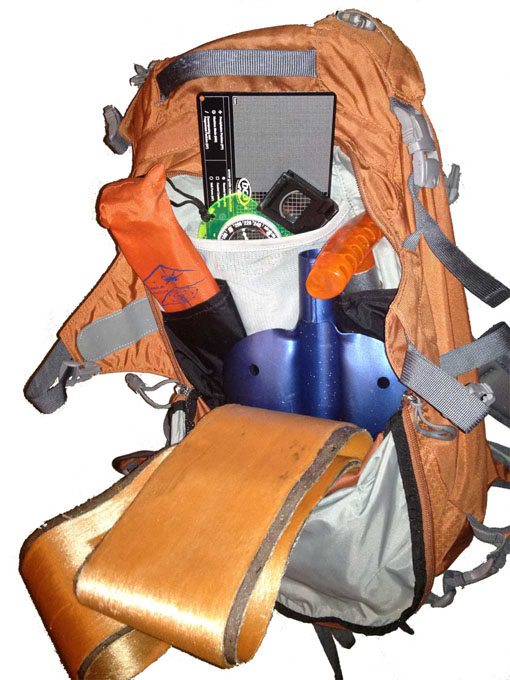
It is obvious that the designers at Osprey really understand skiing in the backcountry, and that they have paid special attention to the organization of the tools we carry, down to the smallest of them. As Kate mentioned, the pack has two major compartments, a wet and a dry. But the wet compartment also includes a center pouch that functions as a snow science tool storage. My compass, slope meter, and snow plate all fit nicely into this pouch, and my beacon also lives there when I’m not touring.
Osprey has also included a key holder in a mesh zippered pocket on the inside of the back flap of the pack. I’ve made this my first aid area, with vitamin B, painkillers, Band-Aids, my multi-tool, and some duct tape.
The wet compartment of the pack also has slots for your probe and shovel handle, while the shovel itself fits into the bottom part of the compartment, which leaves some room for skins. The only drawback here is that I would like more room for my skins. I feel like I’m usually cramming them in and pushing them down to get the zipper closed. (Though the zippers on the pack are otherwise easy to open and close with gloves, thanks to the large loops attached to each zipper, a definite bonus and awesome design feature.)
It’s also clear Osprey has a focus on product longevity. Two snap buckles reach over the top of the shoulder straps, tightening up the load while taking strain off the dry compartment zipper. I have also used them as an external jacket carry when I want grab my shell without opening the dry compartment.
Yet when it’s cold out, these buckles have given me a bit of a problem. They’re kind of small, and when my hands are cold they’re not the best at functioning with smaller buckles. And while the buckles add durability and longevity to the pack, they also add another step to getting to your layers in the dry compartment, which can sometimes be an annoyance.
Could you compare this backpack to the Deuter Freerider 30, if you’ve used it by any chance?
I was so happy when my Kode 30 was stolen from a train in Switzerland. It’s pretty clear that the Osprey folks don’t actually use their packs. I’ve owned 5 different ski packs. I bought a Mammut Nirvana Ride 30, and once I cut off the snowboard carrier, is pretty much close to perfect.
Here’s a little tip for any time you have excess strap you don’t want dangling. Tighten it until it’s comfortable, then loosen it up some for the possibility of more layers in the winter. Roll up the excess, and secure it with a strip of gorilla tape. We do this in the military so extra strap doesn’t snag when exiting a plane or moving through brush.