

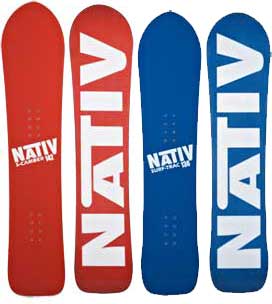
Boards: 2011-2012 Nativ S-Camber 142 / Surf-Trac 136
Waist Width (mm): S-Camber: 253 / Surf-Trac: 252
Nose and Tail Width: 192 / 265 (274 Surf-Trac)
Effective Edge (cm): S-Camber: 112.7 / Surf-Trac: 107.1
Sidecut depth: S-Camber: 19 / Surf-Trac: 18
Shape: Directional
Stance Range (mm): S-Camber: 536 / Surf-Trac: 524
Stance Location: 0, 0
Boots / Bindings: Salomon Faction / Flow The Five
Test Location: Taos Ski Valley
Days Ridden: 9
I don’t know how eager I would have been to ride Nativ boards if I hadn’t already experienced one in college—these boards look incredibly foreign compared with a traditional snowboard. As an undergrad, one of my buddies from Cal Poly, Nate McKeever, a surfer and skater from California, had started hand making what he called Snowsurfs (I called them Snurfs, mostly to make him angry), essentially a snowboard with the tail chopped off. The squash tail (that’s what it’s called in surfing) certainly gets some strange looks in the lift line.
The idea is to have a board that responds more like a skateboard or surfboard. The first time I rode one was at June Mountain in California. I had a blast. The board does handle like a skateboard, turning quickly and transferring edge-to-edge with no problems. June, though, is not exactly extreme terrain, so we were trying out these new creations in the terrain park. I started feeling a little too confident, overshot a landing, and snapped my collarbone. That was the end of my Snowsurf career until this season.
This year I got two Snowsurfs for testing: a 142 S-Camber, made for powder with slight camber underneath and rocker in front, and a 136 Surf-Trac, which has more pronounced camber and an extra point of contact in the minimal tail for grip in the park and in hardpack conditions.

After spending all season riding steeps on traditional boards, I was skeptical of how the Snowsurf boards would perform when things were more vertical. It had snowed significantly a few days prior to my first weekend on these boards, so I thought I’d give the 142 S-Camber a shot in the mixed powder and chop. My justification was that I would need that extra length for hitting Taos’ Kachina Peak or the West Basin.
Out of the gate the board felt good. It was responsive, spun well, and turned on a dime. Without a normal tail, there was a serious lack of swing weight, so I could whip it as fast as I wanted. This came in handy when I dropped into Reforma and West Blitz bumps. It was trippy not to have more tail there to slow me down on turns, so I kept leaning too far over the nose and sliding out. But after a couple of runs, things clicked, and I got my balance correct: I could almost zipper-line through the bumps. Instead of cutting my turns short on the downhill side of the moguls, I could let out the reins, get a little more speed, and draw better lines.
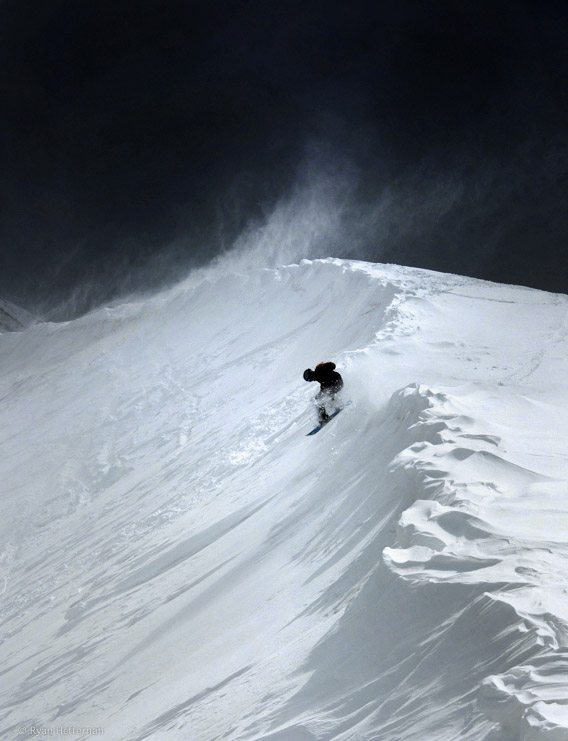
The morning after my first full day on the 142 S-Camber board, BLISTER founder Jonathan Ellsworth, reviewer Garrett Altmann, and I hiked out to Kachina for a run. We spotted what looked like some untracked snow near the last cornice before Main Street and decided to go for it. The wind was howling, and I couldn’t hear a thing as Garrett and then Jonathan dropped in. They hauled through the top section, and I figured I’d do the same, not looking at their tracks—or lack thereof.
I dropped in straight, quickly picked up speed, ripped my first turn heelside, and immediately lost control—I was on a solid patch of ice. I slid for a good 100 feet before I self-arrested. All I could think was, “I wish I had a tail.” (Technically speaking, the Snowsurfs just have an extremely small tail, which costs the board serious stability on hardpack or variable snow conditions.)
I thought the same thing later when I was chasing a pack of skiers down Stauffenberg, a steep run off the West Basin. I hit the hard top of a bump underneath a foot of powder going toeside. A longer tail would have stopped me, but I went hurtling over backward.
So how is this board different from being a shorter burton fish? wouldn’t the extra length in a fish help with the stability issues that you found with this board.
Hi Lance,
I haven’t ridden the Burton Fish but from what I can tell the Fish is supposed to be more like a traditional pow board with a swallow tail (the notched v-shape). You’re only supposed to ride it 3-6 cm shorter than your normal board and they say that you could ride it in the park as well. The Snowsurfs are significantly shorter which I imagine really changes the turning dynamics compared to what you would find with the Fish. I think you’re right, though, the extra length would help with stability issues. Nativ is adding more sidecut and a longer tail next season which should help out with those issues.
Ride it in Japan powder and you won’t believe how much fin it is. So much control and manoeuvrability, especially in the trees. Ive had one for a few years but its one of their original creations, and its still epic.
Riding it anywhere near ice is madness.